From untapped electricity to thriving businesses: CES CARES transforms rural communities by connecting energy infrastructure with economic opportunity.
In Zambia, where 10 million of the country’s 20 million people still lack access to electricity, CES CARES (Customized Applications for Rural Economies & Sustainability) is pioneering an innovative approach that goes beyond simply providing power. By creating rural micro enterprises around existing mini-grid infrastructure, the initiative is addressing local job creation, increase in income of communities, energy poverty, food security, and climate resilience simultaneously.
The Untapped Potential Problem
When CES CARES arrived in Zambia in January 2023, they discovered a paradox: mini-grid operators had built solar power plants and connected villages to electricity, but 60% of the generated power went unused. Households used electricity for basic lighting, but without productive applications, demand remained low and mini-grids struggled to achieve financial sustainability.
“We realized we needed to create small and medium-scale rural businesses around the electrical infrastructure,” explains Nitin Akhade, Executive Director of Energy Access and Livelihoods at CES CARES. “The infrastructure was there, but the economic ecosystem wasn’t.”
Building an Economic Ecosystem, Not Just Power Lines
Rather than viewing electrification as an end goal, CES CARES approached it as the foundation for economic transformation. The team partnered with mini-grid operators including Engie Energy Access (now Ignite), One Power, and North America Rural Electrical Cooperative, Rural Electrification Authority to identify and address local economic pain points.
The Productive Use Revolution
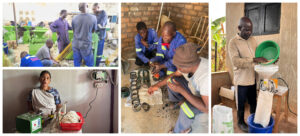
In less than two years, CES CARES has deployed 76 productive use machines across Zambia through multiple partners like SARO Zambia, Agsol, Jacana and Finecop Zambia:
Food Processing Solutions:
– 31 dehullers and 31 hammer mills for processing maize, Zambia’s staple food
– 12 oil expellers producing refined sunflower oil for local markets
– Groundnut decorticators for removing peanut shells
Agricultural Transformation:
– 6 large-scale irrigation projects covering 3 hectares each
– Solar-powered boreholes with drip irrigation systems
– Storage tanks ensuring water availability during droughts
From Basic Processing to Value Addition
The CES CARES approach evolves with community capabilities. “We’re moving from primary to secondary processing,” notes Akhade. “From just de-shelling groundnuts, entrepreneurs now make peanut butter. From extracting oil, they will be bottling and branding it for local markets.”
This progression creates multiple revenue streams:
– Farmers growing and selling raw materials
– Processors adding value through milling and extraction
– Entrepreneurs packaging and marketing finished products
– Animal feed production from processing byproducts
Business Model: The Lease-to-Own Model
Understanding that rural entrepreneurs lack upfront capital, CES CARES developed a sustainable financing model:
– Equipment provided on 24–30-month lease-to-own agreements
– Farmers can generate revenue of $8,000-9,000 per season from irrigation projects for 3 hectares lands
– Loan repayments fund equipment for new entrepreneurs
– Local team provides continuous after sales service support
“The social capital in Zambia is high, but people need support when challenges arise,” explains Akhade. “If a machine breaks and no one helps, motivation disappears. We stay with entrepreneurs for 2-3 years until they’re confident and successful.”
Impact by the Numbers
The results after just 18 months are remarkable:
– 76 productive machines deployed across rural communities
– 25% increase in mini-grid electricity consumption
– 2x income potential for farmers using irrigation systems
– Drought resilience for communities facing three consecutive years of failed rains
– Youth employment created through new processing enterprises
The Triple bottom line Win Solution
CES CARES has created a model where everyone benefits:
- Mini-grid operators achieve financial sustainability through increased electricity sales
- Rural entrepreneurs build profitable businesses with clean energy
- Communities gain food security, employment, and economic growth
Creating Local Champions: Building Zambian Capacity
The initiative’s sustainability comes from local ownership. Benjamin Kafunda leads the Zambian team with two technical specialists, ensuring machines are properly maintained and entrepreneurs receive ongoing training. This local presence means rapid response to challenges and deep understanding of community needs.
“The energy in Zambian youth is impressive,” notes Akhade. “We’re just catalyzing that energy with the right opportunities and support.”
A Model for Africa and Beyond
The success in Zambia provides a blueprint for addressing the water-energy-food nexus across Africa. By demonstrating how productive use of electricity can transform rural economies, CES CARES is attracting attention from other countries seeking similar solutions. This also align with the M300 initiative of empowering 300 million people across Sub-Saharan Africa who lacks access to electricity.
The approach addresses multiple UN Sustainable Development Goals simultaneously:
– Affordable and clean energy (SDG 7)
– Decent work and economic growth (SDG 8)
– Zero hunger (SDG 2)
– Climate action (SDG 13)
– Partnerships for the Goals (SDG 17)
The Road Ahead
With plans to scale successful technologies across Zambia and expand to other African nations, CES CARES is proving that energy access becomes truly transformational when coupled with economic opportunity. The goal isn’t just to light up villages – it’s to power prosperity. Zambia Energy Demand Stimulation Incentive supported by Sustainable Energy for All and Rockefeller Foundation is providing the required in scaling Productive use in Zambia.
As drought-stricken communities now irrigate year-round and youth build businesses instead of migrating to cities, rural Zambia is experiencing a quiet revolution. It’s a revolution powered not just by solar panels and mini-grids, but by the entrepreneurial spirit of communities given the tools to shape their own futures.
—
CES CARES (Customized Applications for Rural Economies & Sustainability) is working to eliminate energy poverty by 2030 through sustainable, scalable solutions. The initiative represents Customized Energy Solutions’ commitment to making meaningful impact in underserved communities worldwide