A metal the world already depends on
For more than a century, Manganese has largely been a steel story. About 96%[i] of global Manganese demand comes from steelmaking. Manganese’s traditional importance comes from its metallurgical properties. It acts as a deoxidizer, desulfurizer and alloying element in steel, improving strength and hardness. Outside steel, Manganese compounds are used in aluminium alloys, dry-cell batteries, fertilizers, animal feed and pigments.
The energy transition, however, is beginning to give this 5th most abundant metal, a second strategic identity. As battery manufacturers search for cathode chemistries that reduce dependence on expensive nickel and cobalt while retaining energy density, Manganese is emerging as an increasingly important ingredient for lithium-ion and potentially sodium-ion batteries. Today, that is only about 1% of total demand, but it is the most strategically important part of the total Manganese market.
Ore types and where Manganese is found
Before assessing Manganese demand from battery-grade applications, it is interesting to first understand the current landscape of Manganese supply and refining. Manganese is mined mainly from two ore families. Oxide ores, such as pyrolusite (MnO₂), psilomelane and braunite, are the most common and often high-grade. Carbonate ores, chiefly rhodochrosite (MnCO₃), are generally lower grade but can be easier to leach. Ores are also classed by Manganese content: high-grade ores above roughly 44% Mn are the most valuable, and medium and low grades go mainly to ferroalloys.
Global reserves are estimated at 1.35 billion tons[ii] (gross weight) and distributed across moderately diversified regions. South Africa alone holds around 41%, followed by Brazil (22%), China (19%), Australia (8%) and Gabon (5%). India holds about 3%. Mine output is relatively concentrated in Africa. Of roughly 20 million tons of Manganese content mined in 2025, South Africa produced about 38% and Gabon 25%. Ghana (10%) and Australia (8%) followed.
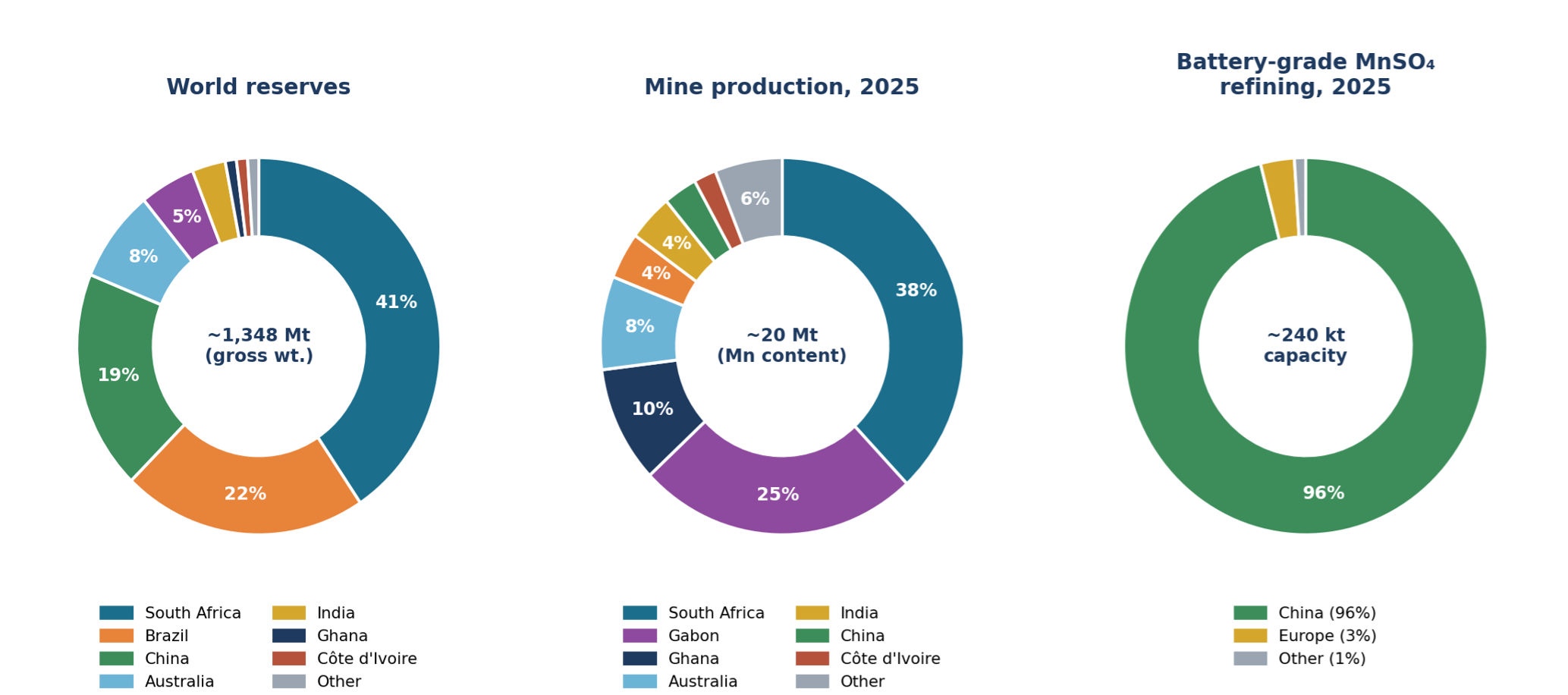
Figure 1: Share of world Manganese reserves2, mine production (2025)2 and battery-grade Manganese sulphate refining[iii]. Source: U.S. Geological Survey. (2026). Mineral commodity summaries 2026 and CES Analysis based on various company announcements
For batteries, the most useful feedstock is high-grade ore from South Africa, Gabon and Australia. The real chokepoint, however, is not mining but refining. China has about 96% of the world’s roughly 240 kt (Mn metal contained basis, sufficient supply for 4TWh of NMC811 batteries) nameplate capacity for battery-grade Manganese sulphate. Europe (mainly Belgium) and Japan account for most of the rest.
Manganese in evolving battery chemistries
Global battery demand for advanced chemistry cells[1] is expected to rise from ~1.9 TWh in 2025 to ~3.7 TWh in 2030 and ~6.1 TWh in 2035[iv]. Similarly global demand for Manganese from Electric Vehicle and Grid-Scale Battery Storage is expected to rise from about 67 kt (~1.1 TWh of NMC811 equivalent) in 2025 to roughly 415 kt by 2030 and nearly 900 kt by 20354. With these transitions, application wise demand for Manganese would also be taking a shift where the share of Manganese demand attributable to battery applications is projected to increase from approximately 1% to around 5% of total4.
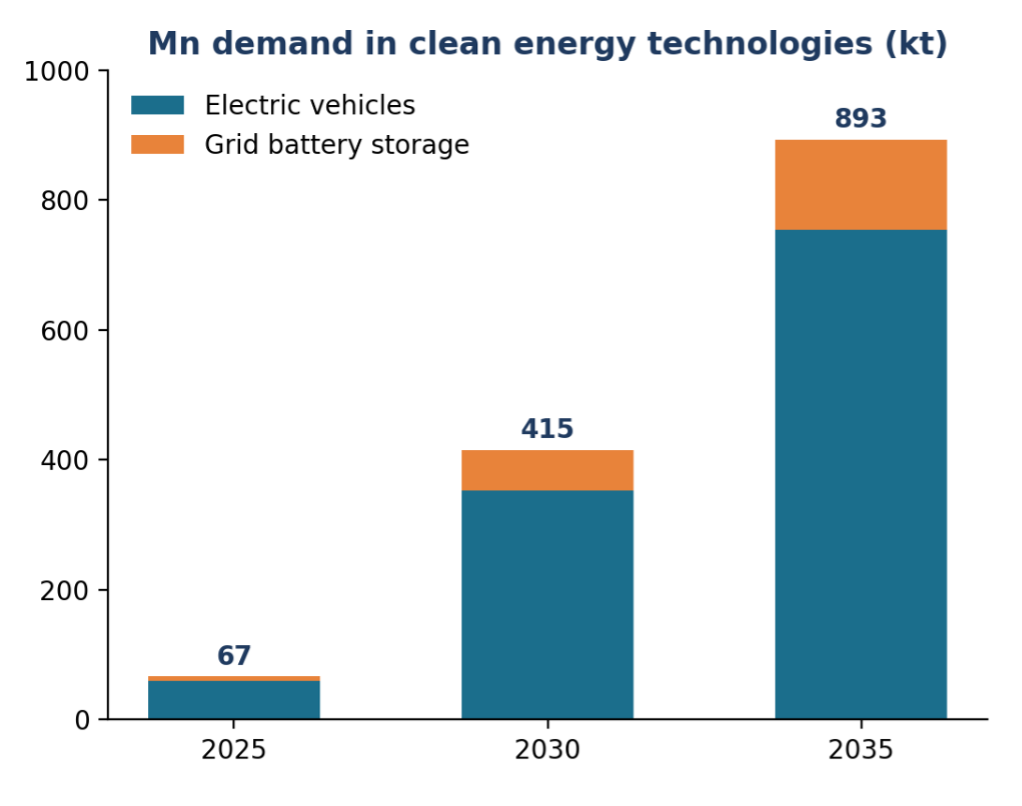
Figure 2: Global Manganese demand from clean energy technologies, 2025 to 2035[v] Source: IEA Global Critical Minerals Outlook 2026
NMC (Nickel-Manganese-Cobalt) remains the main source of demand today. Manganese stabilizes the layered cathode structure and improves safety at a lower cost than nickel or cobalt. With technology improvement in the LFP chemistry, EV batteries have evolved to utilize LFP instead, NMC chemistry would still continue to hold ~38 % share by 2035 in the advanced chemistry battery market driving the long range EVs and e-2Ws4.
Several battery chemistries containing Manganese are on the rise:
Lithium Manganese-rich (LMR) cathodes go much further. They raise Manganese to well over half of the transition-metal content while cutting cobalt and reducing nickel. They promise high energy density at lower cost, and several automakers are targeting them for next-generation EVs later this decade. GM and LG Energy Solution plan to begin commercial production of LMR prismatic cells by 2028 for electric trucks and full-size SUVs, claiming 33% higher energy density than LFP at comparable cost[vi]
LMFP (lithium Manganese Iron Phosphate) adds Manganese to the popular LFP chemistry. This lifts the operating voltage from about 3.4 V to around 4.1 V and increases energy density by roughly 15 to 20%. It keeps LFP’s safety and long cycle life, which makes it attractive for mass-market EVs and storage. Early this year, BYD Auto announced the usage of LMFP chemistry for their Blade 2.0 battery cells.[vii]
Sodium-ion batteries are emerging as a low-cost alternative for stationary storage and entry-level vehicles. Their most commercialized cathodes are layered transition-metal oxides with Manganese as a key element. As sodium-ion scales up, it opens a new demand stream for Manganese that does not depend on lithium. CATL estimated it to deliver 1 GWh sodium-ion chemistry-based BESS by end of 2026 and adding 40 GWh of sodium-ion production capacity at its Fuding base, while its Jining (Shandong) base has 160 GWh of planned sodium-ion capacity[viii]
LMO (Lithium Manganese Oxide) and LNMO (Lithium Nickel Manganese Oxide): LMO chemistry finds use in niche applications like industrial tools, robotics, and other high-power applications while LNMO, with its higher operating voltage and cobalt-free composition, has stronger long-term potential for EVs, fast-charging batteries, hybrid vehicles, and high-energy applications, subject to continued improvements in high-voltage stability and cycle life.
In short, manganese is emerging as a recurring enabler across almost every major cathode technology roadmap.
Making battery-grade Manganese sulphate
Battery-use cathode makers need high-purity Manganese sulphate monohydrate (HPMSM). It typically carries about 32% Manganese at a purity of 99.98% or better (“3N8” to “4N” quality). This differs from traditional steel grade Manganese (ferromanganese) process which primarily requires high temperature smelting of Manganese and Iron ores, and the end products can tolerate impurities to certain extent. Impurities in battery grade Manganese sulphate salt can significantly impact the battery performance and safety.
Production starts by leaching Manganese ore (oxides or carbonates) in sulphuric acid with a reducing agent such as SO₂, ferrous sulphate, iron sulphide or activated carbon. Electrolytic Manganese Metal (EMM) can also be used as feedstock. The leach produces a Manganese sulphate solution that still contains many impurities, including calcium, magnesium, potassium, sodium, iron, and aluminium. It can also contain heavy metals such as lead, arsenic, zinc and copper.
The critical step is purification. Producers combine and repeat several purification methods: fluoride precipitation, sulphide precipitation, solvent extraction, neutralization to remove iron and aluminium, and repeated recrystallisation. The purified salt is then crystallized and dried into HPMSM, ready for use as a precursor for cathode active material.
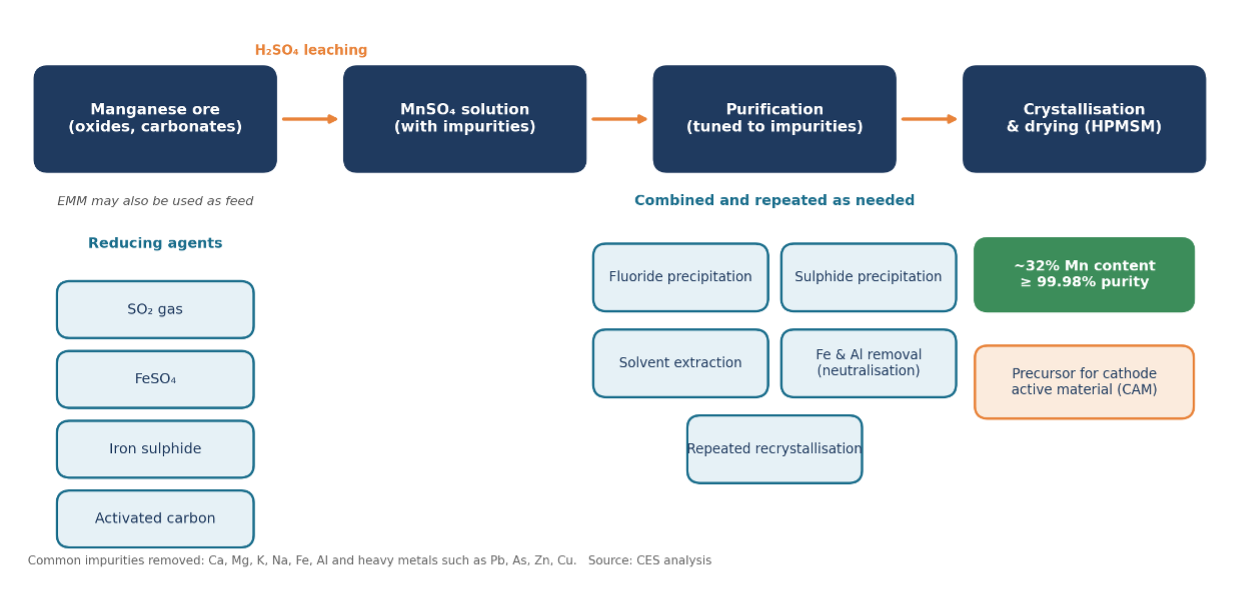
Figure 3: Process flow for producing high-purity Manganese sulphate monohydrate Source: Created from information available at Shanghai Yuantai Chemical Products Co., Ltd. website
This purification is tuned to each ore’s impurity profile, so switching ore sources is technically difficult. A plant designed for one ore cannot easily process ore from another country. That makes diversifying supply hard. Input risks add to this. Sulphuric acid saw supply disruptions and price increases in early 2026 because of the conflict in the Middle East. Producing battery-grade Manganese sulphate brings its own environmental challenges. When ore is leached directly, it leaves behind large amounts of residue containing metals. The purification stage also depends on hazardous chemicals such as SO₂, fluorides, sulphides, ammonia and organic solvents, which generate toxic sludge, risk harmful gas releases & contaminate wastewater.
Supply, demand and pricing
HPMSM prices depend on the supply of high-grade ore, available refining capacity and the balance with demand. Battery-grade supply is estimated at about 229 kt (Mn content) in 2025, well ahead of demand of about 67 kt for EVs and Grid Scale Energy Storage combined. That cushion is expected to disappear. By 2035, demand of around 893 kt is projected to exceed supply of about 775 kt. The supply gap is likely to open after 2030 unless new investments begin around 2027 to 2028.
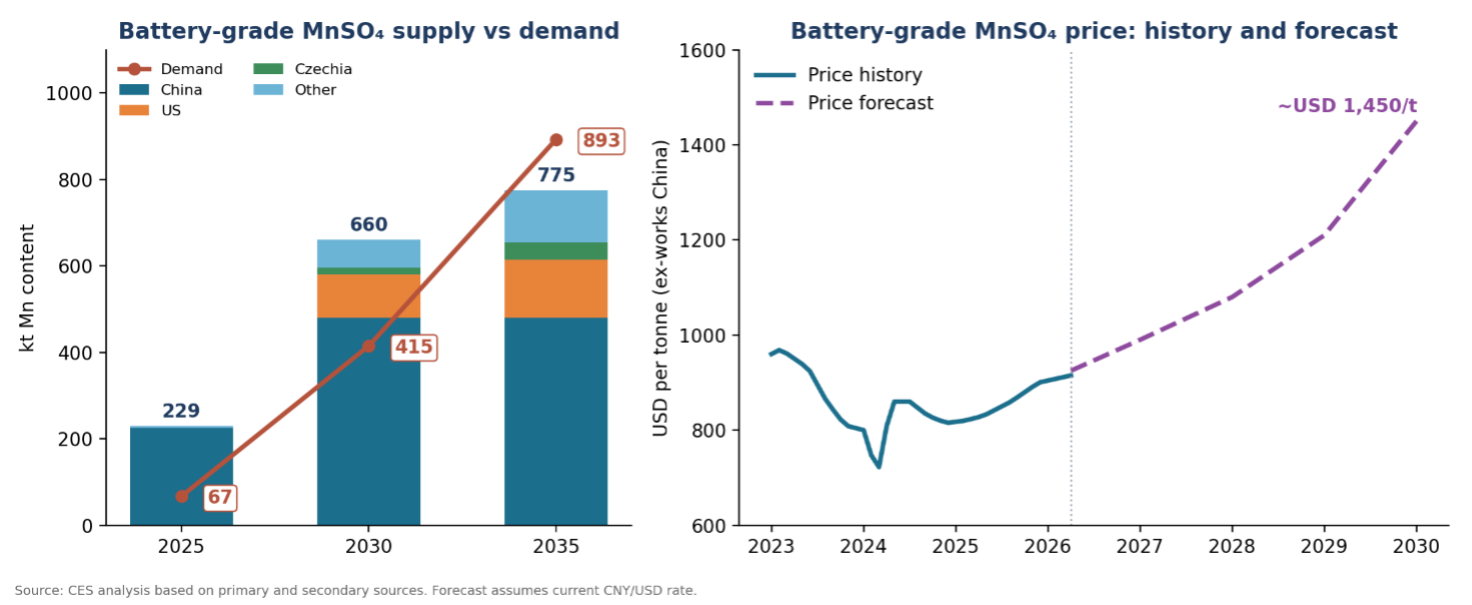
Figure 4: Battery-grade Manganese sulphate supply and demand balance4, and price outlook to 2030 Source: IEA Global Critical Minerals Outlook, 2026, Price Data and forecast based on ICC SINO Ex-Works China price.
Prices have already been volatile. Ex-works China prices for Battery grade Manganese Sulphate fell from about USD 950 per ton in early 2023 to near USD 700 in early 20249. They then rose sharply in 2024 as battery-grade ore supply tightened. By early 2026 prices had climbed back above USD 900 per ton, and forecasts point to around USD 1,450 per ton by 20309. In comparison to other battery grade salts like Cobalt sulphate (~12000 USD per ton)[ix] and Nickel sulphate (~ 4700 USD per ton)9, Manganese prices stand at a mere fraction. But this price difference can be the strategic advantage that Manganese has over other critical minerals for lowering lithium-ion battery prices while maintaining battery performance.
Battery grade Manganese supply could improve with new projects appearing in North America (Element 25, South32, Vibrantz) and Europe (Euro Manganese). However, processing costs in these regions are expected to be 2.5 to 3 times higher than in China5, which will add further upward pressure on prices. Africa is also moving up the value chain with South Africa commissioning its first battery-grade Manganese sulphate plant at Mbombela.
India’s potential in the Manganese supply chain
India holds about 3% of global reserves and contributes roughly 4% of mine production2. Production is concentrated in Madhya Pradesh, Maharashtra and Odisha. State-owned MOIL Limited is the largest producer. It achieved a record Manganese ore output of ~1.9 million tons in FY 2025-26[x], the highest in its history. Its mines span across the Nagpur and Bhandara districts of Maharashtra and the Balaghat district of Madhya Pradesh, and many have operated for over a century. MOIL is also investing to sustain growth. In Odisha, private miners in the Keonjhar and Sundargarh belt supply mainly the steel and ferroalloy industry.
India already has some relevant processing experience. MOIL runs an electrolytic Manganese dioxide plant of 1,500 tons per year[xi] built on indigenous technology, that can potentially be a starting point for battery-grade chemicals.
This is also the opportunity. Manganese is on India’s critical minerals list. Policies such as the National Critical Mineral Mission and the PLI scheme for advanced chemistry cells are building the foundations for domestic battery industry. Driven by the Government backed Advanced Chemistry Cell manufacturing initiative with the Production Linked Incentive Scheme, the demand for battery grade Manganese sulphate is expected to gradually scale up from 2030 supporting indigenous cell manufacturing plans of 150+ GWh.
Customized Energy Solutions has undertaken assignments assessing the gaps and opportunities in India’s lithium-ion cell manufacturing sector as part of its Vision 2047 report[xii] in 2026. While local cathode active material manufacturing scales up, if India invests early in ore beneficiation, impurity-specific purification and HPMSM refining, it could supply its own cathode makers as well as offer a credible source to global buyers. For a market heading into deficit after 2030, that early start could make all the difference.
By: Monami Dey, Market Research Manager-Emerging Technologies, Customized Energy Solutions
References:
[i] African Development Bank. (2021, November). Critical Mineral Insights Manganese. https://www.afdb.org/sites/default/files/documents/publications/Manganese_factsheet_final_nov_21.pdf
[ii] U.S. Geological Survey. (2026). Mineral commodity summaries 2026 (Version 1.3). U.S. Geological Survey. https://doi.org/10.3133/mcs2026
[iii] CES Analysis based on various Manganese sulphate refining company announcements.
[iv] Bielewski, M., Pfrang, A., Quintero Pulido, D. F., Peters, J., Bobba, S., Leccisi, E., Mancini, L., Schade, B., Georgakaki, A., Letout, S., Mountraki, A., & Ince, E. (2026). Clean Energy Technology Observatory: Battery technology in the European Union—2025 status report on technology development, trends, value chains and markets. Publications Office of the European Union. https://doi.org/10.2760/2686206
[v] International Energy Agency. (2026). Global critical minerals outlook 2026. https://www.iea.org/reports/global-critical-minerals-outlook-2026
[vi] General Motors. (2026, September 29). Ultium Cells to bring LMR prismatic battery cell production to Tennessee for future GM EVs Ultium Cells to bring LMR prismatic battery cell production to Tennessee for future GM EVs
[vii] Critchley, L. (2026, March 18). BYD Blade Battery 2.0: How it delivers 1000+ km real-world range. EV Infrastructure & Energy News. https://www.evinfrastructurenews.com/ev-battery/byd-blade-battery-2
[viii] Contemporary Amperex Technology Co., Limited. (2026, June 22). CATL debuts world’s first field-validated sodium-ion BESS, bringing sodium storage to commercial reality. CATL Debuts World’s First Field-Validated Sodium-Ion BESS, Bringing Sodium Storage to Commercial Reality
[ix] Data sourced from ICC SINO, ICC DATA CENTER
[x] MOIL Limited. (2026). Annual report 2025–26. https://backend.moil.nic.in/getFiles/public/document/6a858483X0-Annual_Report_2025-26.pdf
[xi] PSU Connect. (n.d.). How MOIL became India’s largest manganese producer. https://www.psuconnect.in/psu-news/how-moil-became-india-largest-manganese-producer
[xii] Customized Energy Solutions. (2026, February 5). Vision 2047: India’s roadmap for a self-reliant battery ecosystem. Vision 2047 – India’s Roadmap for a Self-Reliant Battery Ecosystem