For years, the EV conversation in India revolved around one number: the price tag on the windshield. That’s changing. As financing options mature and running costs pile up over a vehicle’s life, Total Cost of Ownership (TCO), not the upfront sticker price, has become the number that decides whether an EV makes sense. It’s the difference between asking “can I afford to buy this” and “what will this actually cost me over the years I’ll own it,” and increasingly, buyers and fleet operators are asking the second question.
Three factors drive how quickly that TCO advantage shows up: how much the vehicle is driven each day, its duty cycle (stop-start city driving versus sustained highway running), and how it’s financed. This is why a scooter ridden 10 km a day and a truck running 300 km a day tell very different stories, even though both are “electric versus fossil fuel” comparisons.
In this article, we focus on the heavy truck segment, where the economic case for electrification is arguably the strongest. Commercial fleets cover hundreds of kilometres each day, making fuel costs the largest operating expense over a truck’s lifetime. As a result, the savings from electrification accumulate rapidly, allowing battery electric trucks to offset their higher upfront costs in a relatively short period. This makes heavy trucks one of the clearest demonstrations of how total cost of ownership (TCO) can drive the transition to electric mobility.
While heavy trucks are the focus of this analysis, we have also conducted detailed TCO assessments for other vehicle segments, including E2Ws, E3Ws, E4Ws, and e-buses. Readers interested in those segments can find the complete analysis in our report here: India EV & EV Components Market Report 2026–2032.
Heavy Trucks: BEV Wins Today, Hydrogen Needs a Price Crash
The results shown below are scenario outputs rather than universal benchmarks. They depend on 300 km of daily utilisation, a 12-year ownership period, the assumed purchase and financing costs, electricity and diesel prices, charging losses, maintenance costs, battery replacement, residual values, and annual changes in fuel prices. Readers should interpret the breakeven years and cumulative costs within these modelling assumptions.
In long-haul commercial trucking, a 12-year Total Cost of Ownership (TCO) analysis clearly demonstrates that Battery Electric Vehicles (BEVs) are already the most economically compelling drivetrain under today’s market conditions. While electric trucks continue to carry a higher upfront purchase price than their diesel counterparts, the economics of high-utilization fleet operations rapidly shift the balance in Favor of electrification. Trucks operating on long-haul routes typically cover hundreds of kilometres every day, making energy costs the single largest contributor to lifetime ownership costs. As a result, even modest savings in operating expenses compound significantly over time, creating a powerful economic advantage for BEVs.
Based on research conducted by Customized Energy Solutions (CES), the BEV truck (Tata Prima E.55 S) achieves cost parity with its diesel counterpart (Tata Prima 5530.S) in just two years, assuming a daily utilization of around 300 km. Notably, this calculation already incorporates the cost of a mid-life battery replacement, demonstrating that battery degradation does not materially alter the long-term economic outcome. The reason is simple: diesel fuel costs impose a persistent and growing financial burden over the vehicle’s lifetime. Although diesel trucks benefit from a lower acquisition cost, the savings are quickly eroded by significantly higher fuel and operating expenses.
Tracking cumulative ownership costs year by year illustrates this dynamic clearly. During the initial years of operation, diesel appears competitive and is even marginally cheaper due to its lower purchase price. However, as mileage accumulates, fuel expenditures begin to dominate the cost profile. By the second year of operation, diesel’s cumulative cost overtakes that of the BEV, marking the breakeven point. From that point onward, the cost gap expands steadily as each additional kilometre driven reinforces the BEV’s operating cost advantage.
Over the full 12-year ownership period, the scale of the savings becomes substantial. Based on research conducted by Customized Energy Solutions (CES), the BEV truck ends the analysis period with a cumulative TCO of approximately ₹491 lakh, while the diesel truck reaches about ₹785 lakh. This indicates that the diesel vehicle is nearly 60% more expensive to own and operate over its lifetime, despite its lower initial purchase price. This highlights a critical shift in commercial vehicle economics: upfront purchase cost is no longer the primary determinant of affordability. Instead, lifetime operating expenses increasingly dictate competitiveness, and on that metric BEVs hold a decisive advantage.
Alternative zero and low-emission powertrains also perform better than diesel over the long term, though they do not match the economics of BEVs. The hydrogen internal combustion engine (H2-ICE) truck, represented by the Tata Prima H.55 S, finishes the 12-year period with a cumulative cost of approximately ₹678 lakh. Meanwhile, the fuel-cell electric vehicle (FCEV), represented by the Ashok Leyland 55T, reaches around ₹718 lakh. Both technologies start with significantly higher upfront costs than diesel, delaying the point at which diesel’s mounting fuel expenditure causes it to become the more expensive option. Consequently, cost parity with diesel is achieved much later, typically around year nine or ten.
Nevertheless, the long-term trend remains consistent across all alternative drivetrains. As fuel expenses accumulate over time, diesel steadily loses its initial cost advantage and eventually becomes the most expensive option in the comparison. By year 12, all three alternative powertrains outperform diesel on a TCO basis, with BEVs emerging as the clear winner. The findings suggest that for high-utilization long-haul fleets, the debate is increasingly shifting away from whether electrification can compete economically and toward how quickly operators can capture the substantial cost savings it offers.
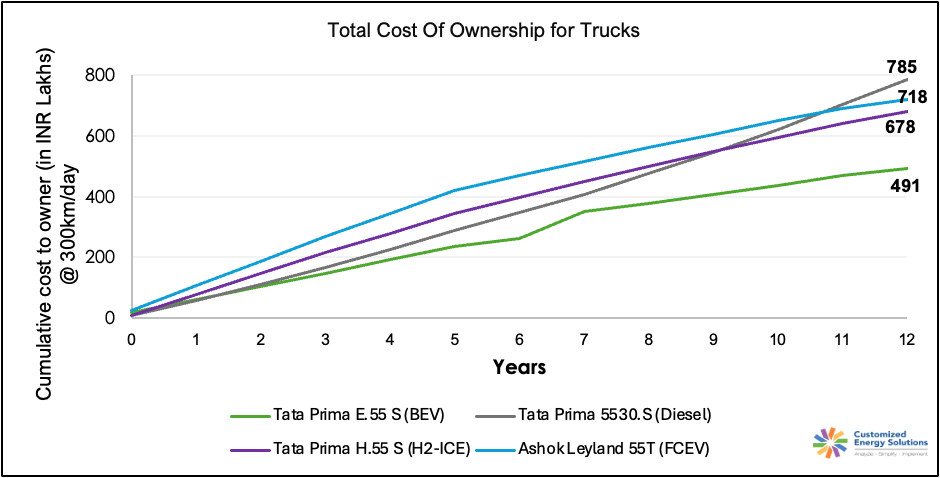
Figure 1: Cumulative cost to owner at 300 km/day, by year, for BEV, diesel, H2-ICE, and FCEV trucks (Source: CES Analysis)
Hydrogen-based pathways present a more nuanced outlook. Both Hydrogen Internal Combustion Engine (H2-ICE) and Fuel Cell Electric Vehicles (FCEV) demonstrate lower lifetime costs than diesel across modelled scenarios, even with hydrogen prices starting at ₹450/kg and declining annually. However, their breakeven with diesel is significantly delayed, occurring around year 11. More importantly, neither technology outperforms BEVs under baseline assumptions.
The key constraint lies in capital costs. The FCEV modelled here, the Ashok Leyland 55T, carries an upfront cost of approximately ₹1.25 crore, a substantial disadvantage compared to the BEV benchmark, the Tata Prima E.55 S, at roughly ₹1.10 crore. While FCEVs benefit from superior fuel efficiency, this advantage is insufficient to offset higher acquisition and financing costs. The H2-ICE Tata Prima H.55 S offers a relatively better position due to lower upfront cost and the absence of an expensive fuel-cell stack, and therefore consistently undercuts the FCEV in TCO.
Based on research conducted by Customized Energy Solutions (CES), for hydrogen technologies to surpass BEVs, fuel prices must decline significantly. Sensitivity analysis of the 12-year TCO highlights this clearly: diesel remains steady at around ₹785 lakh regardless of hydrogen pricing, while the BEV benchmark also stays flat at approximately ₹491 lakh, as neither is dependent on hydrogen costs. The H2-ICE line, however, falls steadily as hydrogen prices decline annually, from roughly ₹678 lakh at ₹450/kg to ₹341 lakh at ₹150/kg, dipping below the BEV benchmark once hydrogen approaches ₹250/kg (about ₹470 lakh). The FCEV follows a similar downward path, from about ₹717 lakh to ₹423 lakh, crossing below BEV only once hydrogen reaches roughly ₹200/kg (about ₹483 lakh). At an aggressive ₹150/kg scenario, both hydrogen pathways clear BEV comfortably. However, emissions considerations remain, as H2-ICE produces NOx, unlike zero-emission FCEVs, which could gain ground if capital costs fall with scale.
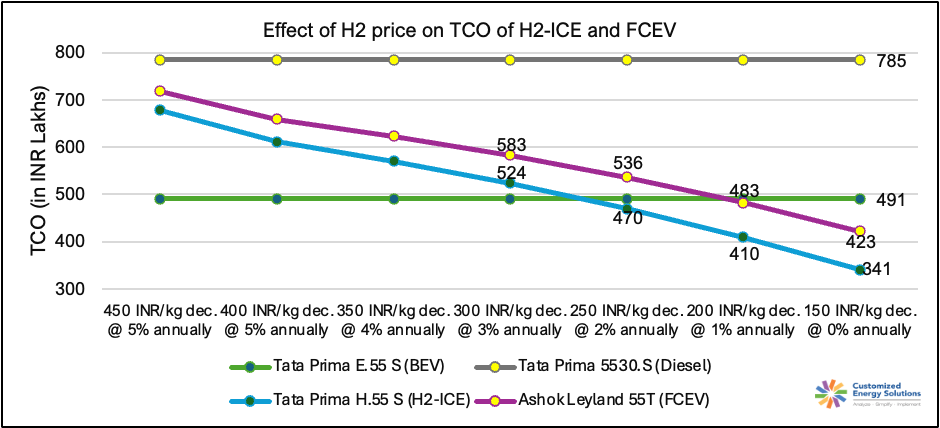
Figure 2: Effect of hydrogen price on 12-year TCO, H2-ICE and FCEV vs. BEV and diesel benchmarks (Source: CES Analysis)
The Takeaway
Across all vehicle segments, the underlying trend is clear: electrification delivers lower lifetime ownership costs, with the economic advantage increasing as vehicle utilization rises. The pathway to cost competitiveness, however, varies by segment. For trucks, the key driver is the elimination of diesel, which typically represents the largest share of operating expenses. In hydrogen-powered vehicles, competitiveness is influenced less by efficiency and more by capital costs and the future trajectory of fuel prices.
As battery prices continue to decline and charging infrastructure expands, the economic case for BEVs is likely to strengthen further across both commercial and passenger vehicle segments. At the same time, higher vehicle utilization accelerates payback periods, making electrification particularly compelling for fleet operators with intensive duty cycles. While hydrogen may play an important role in specific use cases, our analysis suggests that under current market conditions, BEVs represent the most cost-effective pathway to decarbonization across most vehicle categories.
Reference: CES AnalysisReport Links: India EV & EV Components Market Report 2026–2032