The rapid growth of EVs, energy storage systems, and portable electronics has increased demand for high-performance batteries. However, lithium-ion and emerging battery technologies involve complex electrochemical processes and safety risks. Thorough battery testing before commercialization is essential to identify failure modes, ensure safety and performance, meet regulatory requirements, and prevent thermal runaway, field failures, financial losses, and damage to brand reputation.
Introduction
Energy storage systems are the backbone of the modern sustainable economy. As industries pivot away from fossil fuels, batteries are deployed in increasingly demanding environments, from high-vibration automotive powertrains to unmanned aerospace applications and grid-stabilization units. Despite decades of advancement, batteries remain chemically volatile systems storing high energy densities in confined volumes. Commercializing a battery cell, module, or pack is vastly different from producing consumer electronics or standard industrial hardware. A defect in a semiconductor can lead to software crashes; a defect in a commercialized battery can lead to violent fires, toxic gas emissions, and loss of life. Consequently, battery testing is not merely a quality assurance step—it is the foundational gatekeeper of safety, reliability, and economic viability.
Fundamental Failure Modes and the Need for Pre-Market Screening
Understanding why testing is critical requires examining how and why batteries fail. Electrochemical cells degrade and fail through multiple interacting physical and chemical mechanisms. Without pre-market testing under multi-stress conditions, these failure modes remain latent until deployment.
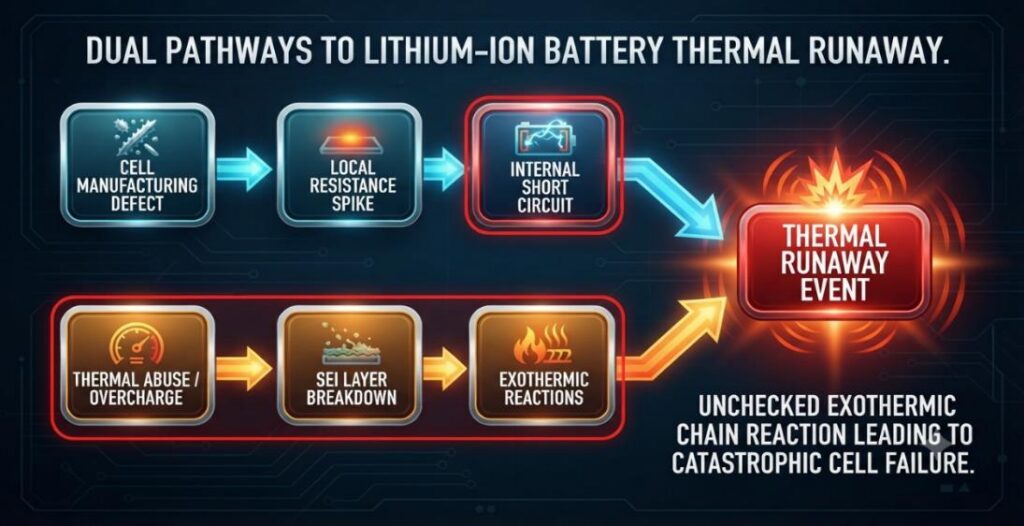
Figure1.Cell Failures-It can originate from internal manufacturing anomalies or external stress factors (AI generated image)
2.1 Internal and External Short Circuits
Internal short circuits (ISCs) can stem from manufacturing defects, such as current collector burrs, foreign metallic particle contamination during winding or stacking, or localized separator damage. External short circuits arise from external wiring faults or crush events. Testing protocols—such as nail penetration, controlled crush tests, and thermal imaging during high-rate discharge—are designed to simulate these scenarios, ensuring that internal safety devices (e.g., Current Interruption Devices [CIDs], Positive Temperature Coefficient [PTC] thermistors, and shutdown separators) trigger effectively.
2.2 Thermal Runaway Mechanisms
Thermal runaway is a self-sustaining reaction caused by excessive heat generation inside a battery. It can involve SEI decomposition, anode and electrolyte reactions, separator melting, cathode decomposition, and electrolyte combustion. Abuse testing helps identify the temperatures at which these reactions begin, enabling engineers to design thermal management systems (TMS) that prevent or limit cell-to-cell propagation.
2.3 Degradation Pathways: Capacity Fade and Impedance Growth
Commercial viability depends heavily on calendar and cycle life. Batteries experience capacity fade through mechanisms such as:
- Lithium Plating: Occurs during fast charging or low-temperature operation when the anode potential drops below lithium/lithium-ion equilibrium.
- Transition Metal Dissolution: Cathode metals leach into the electrolyte and migrate to the anode, poisoning the SEI.
- Electrolyte Oxidation/Reduction: Continuous parasitic reactions consume active lithium inventory.
Accelerated Aging Tests and Electrochemical Impedance Spectroscopy (EIS) are critical to quantify these degradation kinetics under varied stress profiles prior to market entry.
3.Comprehensive Performance Characterization Testing
Before deployment, a battery’s baseline and operational boundaries must be thoroughly mapped through dedicated performance testing. These tests establish the fundamental efficiency, health, and dynamic response metrics of the cell.
Key Performance Test are –