Introduction
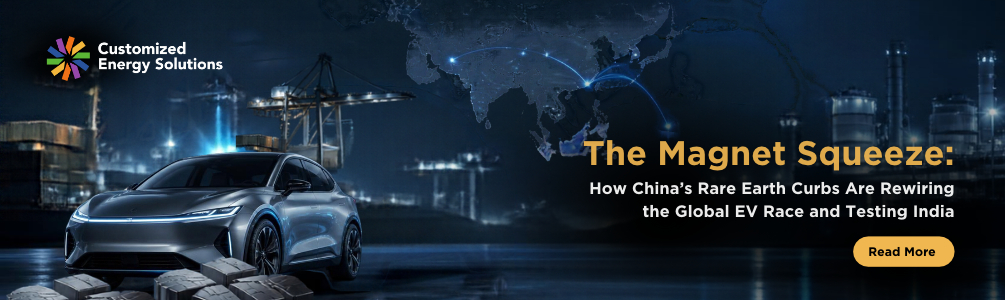
The global transition to electric mobility relies on a supply chain that includes more than just lithium, nickel, and cobalt. Rare earth permanent magnets, though less visible, are strategically important for EV motors because they improve power density, efficiency, and performance. China’s dominance in rare earth processing and magnet manufacturing has exposed a major vulnerability in the global automotive supply chain through restrictions on materials like dysprosium and terbium.
China’s export controls, introduced in April 2025 on seven medium and heavy rare earth elements (samarium, gadolinium, terbium, dysprosium, lutetium, scandium, and yttrium) along with their related compounds and permanent magnets, have transformed rare earth magnets from a specialized industrial input into a strategic economic and geopolitical issue1. Licensing requirements have disrupted shipments, tightened supply, and driven up prices outside China. Automakers now face increased uncertainty regarding component availability, production costs, and electrification timelines.
Despite having substantial rare earth resources and a rapidly growing EV market, India remains heavily dependent on imported sintered neodymium-iron-boron (NdFeB) magnets. India’s efforts to build domestic magnet manufacturing, develop integrated processing, and attract technology partners reflect the understanding that access to raw materials alone is insufficient; the country must also convert them into high-value industrial products.
China Tightens the Tap
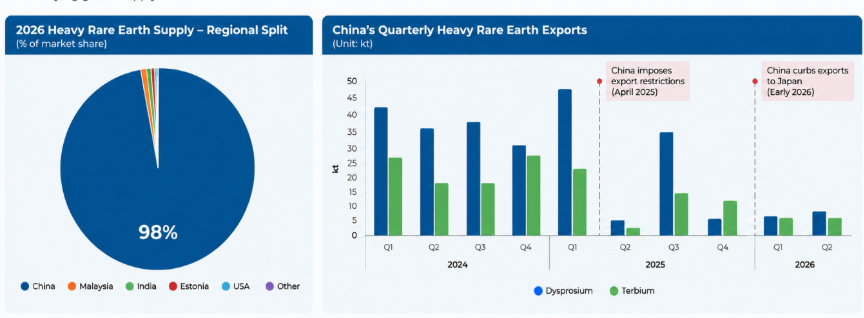
China produces about 98% of global heavy rare earths, giving it significant control over elements like dysprosium and terbium2. These materials are essential for maintaining magnet performance at high temperatures, and viable substitutes are limited. Japan initially maintained a limited supply through late 2025 due to established trade relationships with Chinese suppliers. However, as tensions over Taiwan increased, China further restricted shipments to Japan. By early 2026, exports of dysprosium and terbium to most major markets had dropped to negligible levels.3
Manufacturers of NdFeB based permanent magnets, particularly those supplying the electric vehicle (EV), wind energy, and industrial motor industries, add small amounts of heavy rare earth elements such as dysprosium (Dy) and terbium (Tb) to improve the magnets’ coercivity and resistance to demagnetization at elevated temperatures. These additions help maintain magnetic performance under high-temperature operating conditions, particularly in EV traction motors and other high-performance applications. While NdFeB magnets are valued for their high magnetic energy density, dysprosium and terbium primarily enhance thermal stability and resistance to demagnetization, rather than directly increasing magnetic energy density; excessive additions can, in fact, reduce remanence and increase material costs.
Figure 1. Global Heavy Rare Earth Supply
Sources: Benchmark Intelligence
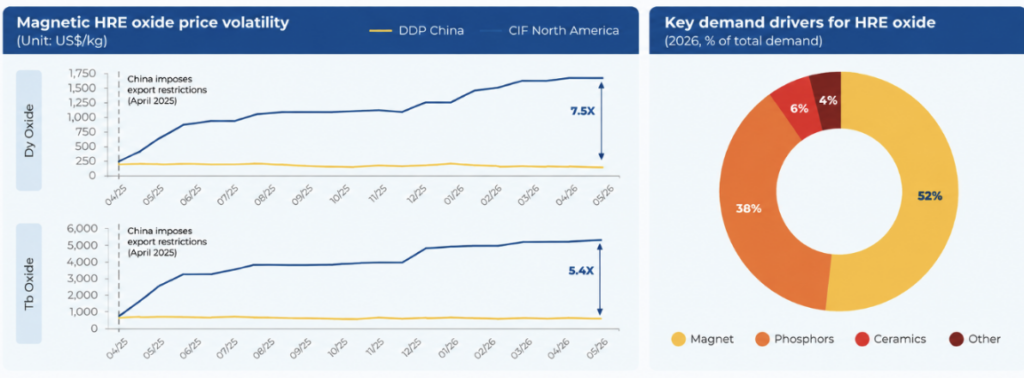
Since April 2025, dysprosium oxide prices in markets outside China have increased by around 7.5 times and terbium oxide prices by around 5.4 times, while Chinese domestic prices have changed comparatively little4. Dysprosium oxide sells for about US$200/kg in China versus US$1,000-1,500/kg in North America. Terbium oxide is priced near US$900/kg in China but trades between US$4,000 and US$5,500/kg in North America5. Dysprosium prices are expected to rise up to 10.5 times current levels before easing as new supply becomes available.
Figure 2. Heavy Rare Earth Oxide Price Volatility
Sources: Benchmark Intelligence
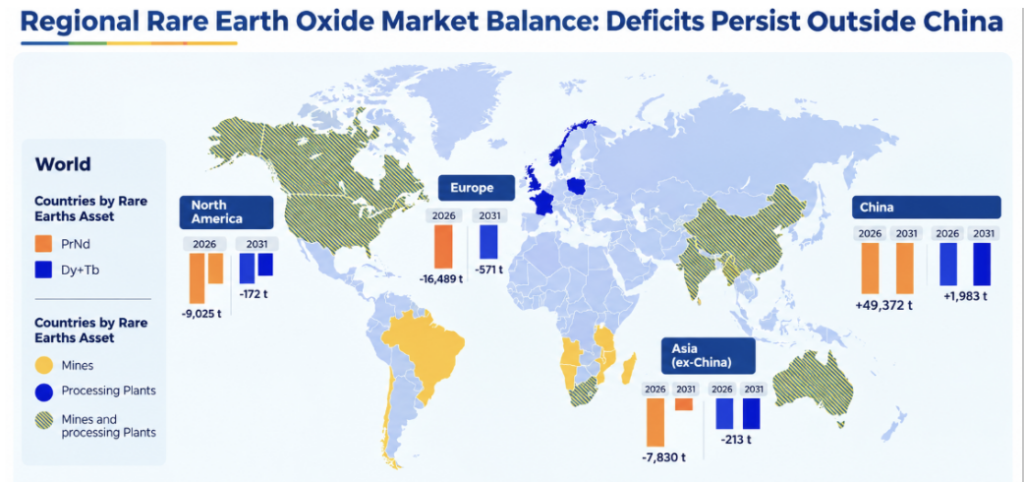
Industry market analysis indicates that every region outside China is expected to remain in rare earth oxide deficit through 2031, even as investment in mining and processing gradually narrows the gap. Significant new supplies of dysprosium and terbium are not expected before 2028. Producers in North America, Europe, South Korea and Japan cannot readily access China’s domestic surplus. Regional market balances indicate a deficit of roughly 10,000 tons of neodymium-praseodymium (NdPr), the light rare earth used in the base magnet alloy outside China, along with a further deficit of about 200 tons in the heavy rare earths covered by export controls6.
Figure 3. Global Rare Earth Oxide Supply–Demand Outlook
Sources: Benchmark Intelligence
India’s Exposure: High Dependence on Imported Magnets
India sits at the intersection of the global magnet supply squeeze and one of the world’s fastest-growing EV markets. In 2025, India imported around US$200 million worth of rare earth magnets for automotive and other applications, with approximately 540 tons came from Chinese producers7. This dependence contrasts with India’s resource base. The country has an estimated 6.9 million tons of rare earth reserves, the world’s third-largest according to the US Geological Survey8. However, its global production share is under 1%, leaving downstream high-tech manufacturing nearly 100% dependent on imports. However, the government has launched aggressive scaling targets, including a plan under the National Critical Mineral Mission (NCMM) to triple rare-earth oxide production to 13,000 tons by 20329. Limited investment in processing and magnet manufacturing has left India reliant on imports for finished magnets. The main gap isn’t just access to resources, but the ability to process them and manufacture magnets at scale.
Where the EV Industry Is Feeling It
Rare earth permanent magnets power permanent magnet synchronous motors (PMSMs) and certain brushless DC (BLDC) motors, which are widely used across India’s electric mobility sector. Their high torque density, compact size, and energy efficiency make them well suited for electric propulsion, though not all electric motors use rare earth magnets. Maruti Suzuki halted production of its e-Vitara electric SUV model in 2025 as magnet supplies tightened10. The disruption pressured the company’s annual target of about 67,000 units for the model, though it has been working to recover the shortfall.11
Cost exposure is especially significant in high-volume, price-sensitive segments. Electric two-wheeler BLDC motors typically cost ₹8,000 to ₹15,000 depending on power rating, with rare earth magnets making up about 30% of the cost12. PMSM motor prices vary by design and integration level, with publicly listed 2 kW mid-drive units priced at approximately ₹17,000 and above. Even moderate price increases can impact the economics of an entire segment. Industry bodies SIAM13 and ACMA14 have urged the government to expedite import clearances and pursue diplomatic solutions, warning that delays in critical components can halt production lines, especially for smaller two-wheeler suppliers15.
Localization Deadlines Under Strain
Electric buses and truck motors are especially magnet-intensive, typically using 3-5 kg or more of NdPr-based magnets per vehicle, increasing supply-chain exposure as heavy-vehicle electrification grows16. India’s rare earth magnet supply constraints have affected motor localization under the PM E-Drive scheme. The initiative aims to promote domestic manufacturing of traction motors for electric buses and trucks. However, limited availability of rare earth magnets has led the government to temporarily permit imports of fully assembled magnet-based traction-motor subassemblies, rather than requiring manufacturers to source magnets separately and assemble the motors locally, with localization originally scheduled for September 202617. With the September 2026 deadline already passed and heavy rare earth supplies still limited, SIAM has formally asked the government to defer the localization requirement for traction motors and controllers until April 2027.
Building an Indian Magnet Supply Chain: From Mine to Magnet
India’s policy response is gaining momentum. In November 2025, the Union Cabinet approved the ₹7,280-crore Scheme to Promote local manufacturing of sintered rare earth permanent magnets, administered by the Ministry of Heavy Industries. The scheme aims for 6,000 tons per year of integrated magnet-manufacturing capacity, covering the full process from rare earth oxides to finished sintered NdFeB magnets.18 19. As of August 2026, 20 companies had submitted bids under the scheme, with five beneficiaries to be selected through competitive bidding, each allocated 600-1,200 tons per annum of manufacturing capacity. The scheme provides ₹750 crore in capital subsidies for manufacturing facilities and ₹6,450 crore in sales-linked incentives over five years to promote domestic production of sintered NdFeB magnets20. Industry estimates suggest India’s demand for rare-earth permanent magnets (REPMs), primarily sintered NdFeB magnets, will rise significantly from 4,000 tons in 2025 to 8,000 tons in 2030. The proposed 6,000-tonne annual capacity could meet approximately 73% of projected demand of 8,220 tons, leaving a potential gap of 2,220 tons per year21.
The Bhabha Atomic Research Centre commissioned a rare-earth permanent magnet plant in Visakhapatnam in 2023, while Hyderabad-based Midwest Advanced Materials is scaling up its sintered NdFeB magnet facility with an investment of ₹250 crore. The plant, with an initial capacity of 500 tons per annum, is undergoing trial production, with commercial operations expected by mid-October 2026 22.
Japan-based Proterial has proposed investing in a sintered NdFeB magnet plant in Andhra Pradesh. According to Rare Earth Exchanges (5 October 2026), the company plans to invest ₹2,250 crore in a facility with a planned capacity of 1,200 tons per year. Proterial is also among 20 bidders for the government’s ₹7,280-crore rare earth permanent magnet manufacturing scheme. If implemented, the facility would increase India’s domestic magnet-making capacity, though its output would cover only part of the country’s broader needs, especially in downstream manufacturing; however, securing rare-earth oxides remains a critical upstream challenge. The company has also presented a front-engine vehicle (FEV) motor concept combining an amorphous-alloy core with HRE-free magnets which achieved 300 kW output, a 27% reduction in motor weight, and 97.9% WLTP efficiency23. These are concept-level results, not proof of commercial deployment. Several Indian companies are developing alternative motor technologies to reduce dependence on rare-earth magnets. Simple Energy has introduced a motor that eliminates heavy rare-earth elements, while Chara Technologies, Sterling Gtake-Advanced Electric Machines, and Sona Comstar-Enedym are developing magnet-free motors based on synchronous or switched-reluctance technologies. Conifer is pursuing ferrite-magnet-based alternatives, while Vimag Labs is developing magnet-free motor technology
Conclusion
India’s rare-earth magnet challenge is ultimately a broader rare-earth supply-chain problem. While the government’s manufacturing scheme supports downstream capacity, long-term resilience will depend on securing adequate feedstock, expanding domestic separation and refining, and strengthening magnet and motor manufacturing. IREL (India) Limited, formerly Indian Rare Earths Ltd reported rare-earth oxide production of around 500 tons per annum raises a critical question: can domestic output scale sufficiently to meet growing local demand and potential export requirements24? Increasing production alone will not permanently resolve India’s dependence; success will require an integrated value chain, diversified sourcing, recycling, and commercially viable alternatives such as heavy-rare-earth-free magnets and magnet-free motors. Ultimately, India’s progress will depend on execution and reliable access to materials at every stage, from rare-earth oxides to finished motors.
By: Monami Dey, Market Research Manager-Emerging Technologies, Customized Energy Solution