Copper’s Critical Role in Lithium-Ion Batteries
Copper is emerging as one of the most strategic materials for the global energy transition, driven by rising demand from electric vehicles, lithium-ion batteries, renewable energy, power grids, energy storage, AI-driven data centers, and EV charging infrastructure. In batteries, copper is indispensable as the anode current collector and is used across all major chemistries, including LFP, NMC, and LMFP. With battery electric vehicles requiring nearly 60-90 kilograms of copper than conventional vehicles (20-25 kilograms)1, demand is expected to grow rapidly. In India, expanding giga factories, renewable energy deployment, and electrification are creating significant opportunities for domestic battery-grade copper foil manufacturing. However, rising global copper prices, supply constraints, and continued dependence on imported copper concentrates highlight the need to strengthen India’s domestic mining, refining, and recycling ecosystem to ensure long-term supply security.
Rising Copper Demand Beyond Electric Vehicles
Copper is important for more than just electric vehicles. Solar and wind farms use much more copper than traditional power plants. Upgrades to power grids, battery storage systems, AI-powered data centers, and EV charging stations are all pushing global copper demand higher. Because of this, many experts see copper as one of the most important materials for meeting climate and energy transition goals.
India’s need for copper is growing as the country ramps up lithium-ion battery production, electric vehicle manufacturing, renewable energy projects, and power infrastructure. Battery-grade copper foil, used as the anode-current collector in lithium-ion cells, is a major factor behind this demand. As India builds more factories and moves toward large-scale production, the need for high-purity, ultra-thin copper foil will rise. The industry is also moving to thinner foils to boost energy density and battery performance, making advanced copper foil manufacturing even more important.
Hindalco Industries has recognised this opportunity and plans to begin producing battery copper foil as part of its strategy to produce key battery materials in India. The company says it is looking into copper foil development as part of its long-term battery materials plan, alongside its investments in battery-grade aluminum foil.
Even though demand is rising, India still has limited capacity to produce battery-grade copper foil and relies mostly on imported copper ore. This creates a significant opportunity for investment in local copper foil manufacturing, which could strengthen the battery supply chain, improve supply security, and help India’s electric mobility and energy storage goals.
Copper Price is skyrocketing in 2026 as compared to 2025
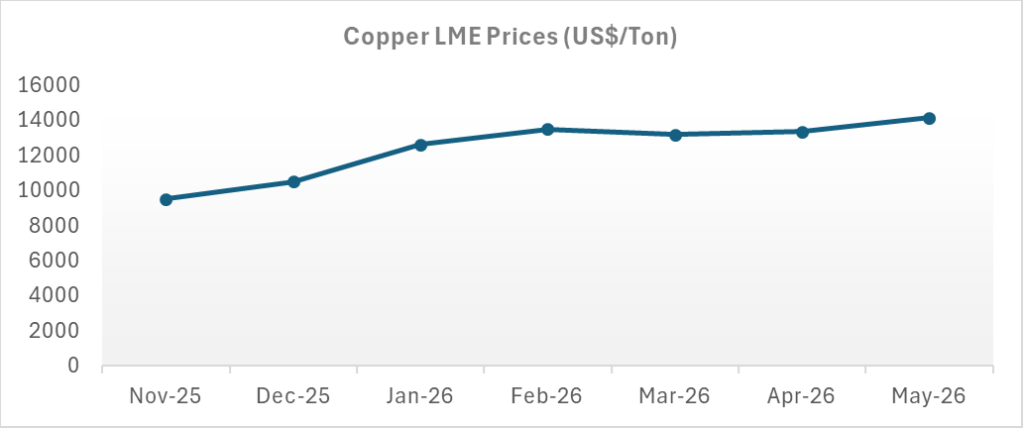
Copper prices are likely to remain much higher in 2026 than in 2025, driven by strong demand and ongoing supply constraints. As shown in the figure below, LME copper prices are expected to rise from about US$9,500-10,000 per ton in late 2025 to over US$13,000-14,000 per ton in 2026, showing a clear upward trend.
Figure1: Copper LME Prices (US$/Ton), 2025-26
Source: LME
This price escalation is primarily driven by accelerating demand from electric vehicles, battery manufacturing, renewable energy projects, grid expansion, AI-driven data centers, and electrification initiatives, all of which are highly copper-intensive. At the same time, global copper mine supply growth remains constrained by declining ore grades, permit delays, geopolitical risks, project execution challenges, and disruptions at major mining operations. Several industry forecasts indicate that the refined copper market is moving into a supply deficit during 2026, while inventories remain relatively tight2. Additional support for prices has come from trade policy uncertainty, stockpiling, and concerns about the availability of copper concentrates for smelters. As a result, the structural imbalance between rising demand and limited supply additions is expected to keep copper prices elevated throughout 2026
Global Copper Mining Landscape: Can Supply Keep Pace?
Copper mining remains highly concentrated, with Chile as the top producer, accounting for almost a quarter of global output. Peru, the Democratic Republic of Congo, China, and the United States follow. Even with large reserves, industry faces significant challenges3. In many older mining areas, ore grades are falling, so miners have to process more rock to get the same amount of copper. In the Year 2025, the World refined copper consumption was 28.20 million tonnes whereas World mine production was 23.20 million tonnes as copper metal & refined copper production was 28.66 million tonnes4. As a result, the global copper market is expected to face a structural supply deficit with several forecasts projecting a gap of 5-6 Mt by 2035 if new mining capacity is not developed.
Environmental permits, community approvals, and infrastructure construction have significantly delayed copper mining projects. It can take over ten years to go from finding a new copper deposit to starting production, so supply can’t keep up with fast-growing demand. Most new copper supply is expected from a few medium-sized projects, like the Cobre Panama Restart, while many others are still being planned or developed. This means copper supply growth could be delayed, raising the risk of shortages just as demand from electric vehicles, renewable energy, grid upgrades, and battery manufacturing is rising.
Figure2: Copper Project Pipeline Status and Capacity
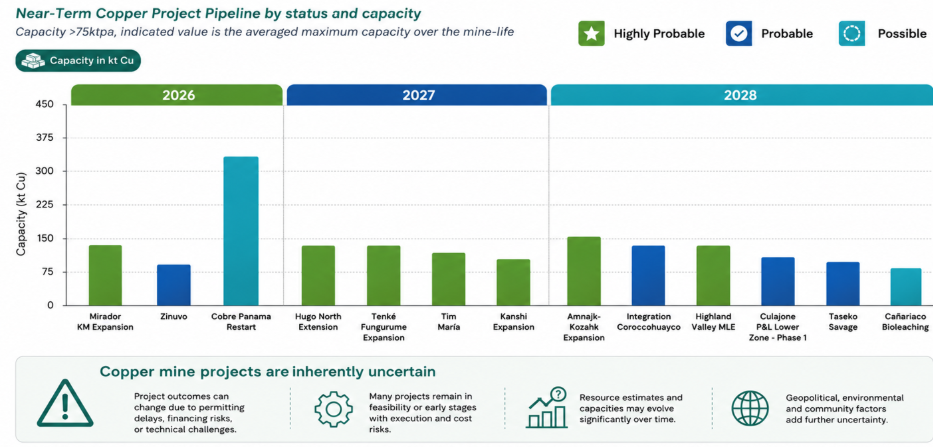
Source: Benchmark Minerals
India has about 1.66 billion tonnes of copper ore resources5, but only a small portion can be profitably mined, so the country still depends on imported copper concentrates6. Most of the copper mining in India happens in Rajasthan, Madhya Pradesh, and Jharkhand, with Hindustan Copper Limited as the main producer HCL’s goal to boost ore production to 12.2 million tonnes per year by 2030-31 from 3.7 million tons (2025-2026) , but it’s unclear how much domestic supply will grow. As demand for electric vehicles, batteries, renewable energy, and power infrastructure rises, India will likely continue to rely on imported copper for the next several years.
Sulphuric Acid: An Emerging Risk to Copper Production
Another important issue for copper production is the availability of sulphuric acid. About 20% of the world’s copper is made using the Solvent Extraction-Electrowinning (SX-EW) process7, which is common in Chile, the DRC, and parts of the U.S. This method needs 15-45 kg of sulphuric acid per tonne of oxide ore processed, although acid consumption can vary depending on ore characteristics and operating conditions. If sulphur and sulphuric acid become harder to get, production costs could rise, and future copper output could be limited. This is especially important because sulphuric acid is also used in refining lithium, processing nickel, and making cathode materials, so there is competition for it across several battery supply chains8.
The U.S. Refined Copper Tariff Proposal
One of the most significant developments affecting the copper industry is the proposed tariff structure on imported refined copper in the United States. According to industry discussions, the U.S. administration has suggested implementing a 15% tariff on imported refined copper beginning in 2027, increasing to 30% from 2028 onward9. The objective is to encourage domestic investments in smelting and refining while reducing dependence on imported refined copper. Currently, the United States imports nearly half of the copper it consumes, making it vulnerable to global supply disruptions and geopolitical risks.
Potential Impact on Global Copper Prices and Trade Flows
The proposed tariffs could have important implications for global copper pricing. The world’s primary copper benchmark, the London Metal Exchange (LME), is a duty-free international price that excludes import tariffs. In contrast, the CME copper market in the United States reflects domestic market conditions and can incorporate the impact of tariffs and duties. If tariffs are implemented, CME copper prices could trade at a significant premium relative to LME prices, creating a divergence between U.S. and international markets. This could encourage shifts in global trade flows, increase arbitrage opportunities, and contribute to greater price volatility across the copper industry.
Table1: Impact of Tariff on Copper Prices
| Copper Prices | Price (June 2026) | Tariff Applied | Implied US Domestic Price | Domestic Premium |
| LME Copper | $13,572/t | None | $13,572/t | |
| US at 15% Tariff | $13,572/t | 15% | ~$15,608/t | +$2,036/t |
| US at 30% Tariff | $13,572/t | 30% | ~$17,644/t | +$4,072/t |
Source:10
If the LME copper price is US$13,572 per ton, a 15% tariff would raise the U.S. domestic price to about US$15,608 per ton, adding a premium of around US$2,036 per ton. If the tariff goes up to 30%, the U.S. price would jump to about US$17,644 per ton, more than US$4,000 above the global benchmark11. This shows that copper prices are now shaped not just by supply and demand, but also by trade policies and geopolitics. These tariff-driven premiums can raise costs for industries like electrical equipment, construction, EVs, batteries, and renewable energy. The resulting price differences across regions may also alter global copper trade, encourage stockpiling, boost domestic production, and create uncertainty for manufacturers that rely on imported copper.
India’s refined copper industry is moving from reliance on imports to greater self-sufficiency as new smelting and refining plants begin operating. After the Sterlite Copper plant closed in 2018, refined copper imports rose sharply, but recent investments by Hindalco, Adani, Vedanta, and Hindustan Copper are now boosting local manufacturing.
The impact of U.S. copper tariffs on India’s refined copper industry is expected to be mixed, with more indirect effects than direct disruptions. Since India is currently a net importer of refined copper and copper concentrates, the country is less exposed to copper export restrictions than major exporting nations such as Chile and Peru. Industry assessments indicate that the direct impact on India’s copper sector is likely to be limited, as domestic demand exceeds domestic supply and imported raw materials account for a significant share of consumption.
However, tariffs can affect India in several indirect ways. For example, changes in global trade caused by tariffs can make copper prices more volatile. U.S. buyers might stockpile copper before tariffs take effect, making it harder to find and raising prices worldwide. Later policy changes could cause prices to drop quickly. This kind of price volatility makes it harder for Indian smelters, cable makers, transformer producers, and battery supply chain companies to plan their purchases.
Implications for the Lithium-Ion Battery Industry
For the lithium-ion battery industry, higher copper prices could increase costs throughout the value chain. Copper foil manufacturers would face higher raw material costs, which could eventually affect battery cell producers and electric vehicle manufacturers. While copper accounts for only a small share of total battery pack costs compared with cathode materials, sustained increases in copper prices could still affect overall battery economics. Moreover, sectors such as power transmission, renewable energy infrastructure, and data centers consume even larger quantities of copper than battery manufacturing, meaning that elevated copper prices could increase capital expenditure requirements across the broader energy transition ecosystem.
India’s Opportunity in a Changing Copper Landscape
India faces both challenges and opportunities as the copper market changes. As the country grows its electric vehicle, battery cell, renewable energy, and data center industries, copper demand will rise sharply. But India still relies on imported copper concentrates and refined copper for many uses. Any problems in the global copper trade or long-term price increases could make it harder for India’s battery and clean energy industries to compete.
At the same time, this situation gives India a chance to boost its own copper refining, grow copper recycling, invest in making battery-grade copper foil, and build partnerships with major copper-producing countries. As India aims for large-scale battery production and more electric vehicles, copper could become as important as lithium, nickel, graphite, and rare earths.
Conclusion: Copper’s Strategic Importance in the Energy Transition
Copper is set to become one of the most important materials for the global energy transition. With demand for electrification rising, long mine development times, possible sulphuric acid shortages, and changing trade policies, copper markets could face more pressure in the next decade. The proposed U.S. tariffs on refined copper are part of a bigger global move toward resource security and local supply chains. For battery makers, car companies, energy developers, and policymakers, making sure there is enough copper will be just as important as securing lithium, nickel, and other battery materials in the push for a more electrified future.