Introduction
The lithium market has entered a new phase of uncertainty. After two years of oversupply and low prices, demand led by energy storage has outrun forecasts, while supply has been hit by mine curtailments, regulatory change and geopolitical disruption. Battery-grade lithium carbonate fell to about $8 per kilogram in mid-2025, squeezing higher-cost producers and triggering industry-wide cuts. Spot prices then briefly reached around $26 per kilogram in the first quarter of 2026, more than three times that low, before stabilizing at about $18 to $21.9 per kilogram by August 2026[1]. Strong demand, shrinking inventories, mine disruptions and export-policy changes keep the market volatile even as it tightens.
The implications go beyond mining and refining. Carbonate, hydroxide and spodumene sit at different points in the chain: carbonate benefits from LFP batteries and grid-scale storage, hydroxide is tied to high-nickel NMC chemistries, and spodumene concentrate is the feedstock that determines how much of either China’s converters can produce.
This matters most for India, where cell and cathode active material (CAM) production is rising but upstream lithium remains almost entirely imported. Global price swings therefore feed directly into the cost competitiveness of Indian battery manufacturing: the challenge is not only building capacity but securing reliable, competitively priced feedstock to run it.
Lithium Market Moves From Oversupply Toward Tighter Conditions
The turn came once prices fell below levels sustainable for higher-cost producers. By mid-2025 carbonate had dropped to roughly US$8-9 per kilogram and CATL suspended its Jianxiawo mine in Jiangxi[2]. Arcadium Lithium placed Mt Cattlin into care and maintenance[3], Pilbara Minerals idled part of Ngungaju, Liontown slowed the Kathleen Valley ramp-up and SQM cut capital spending pulling meaningful volume out of the seaborne market.
China remains the pivot point. Despite holding only around 16.5% of global reserves, it is the largest importer of lithium ore and produces more than 70% of global cathode material[4]. Raw-material supply was still projected to grow roughly 10% in 2026 to about 1.63 million tonnes of lithium carbonate equivalent (LCE), but demand growth is now expected to outrun it[5].
Figure 1: Price Trend of Lithium Carbonate vs Lithium Hydroxide
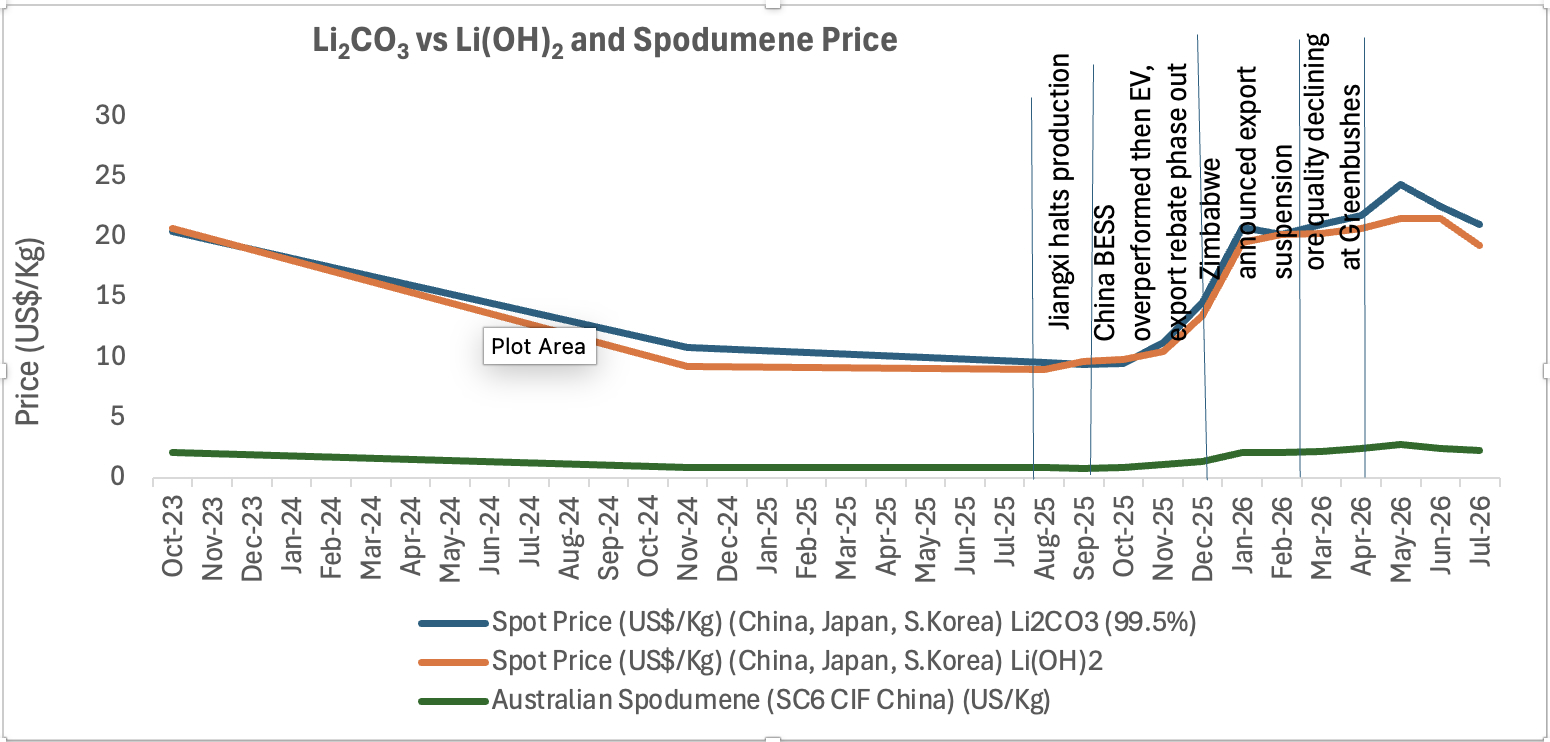
Sources: Fastmarkets, Benchmark Mineral Intelligence, Pilbara Minerals, S&P Global Commodity Insights. Figures are indicative spot assessments and vary by index provider and delivery basis.
Sentiment reversed in the seasonally stronger fourth quarter of 2025, and the expected early-2026 slowdown proved milder than forecast: energy-storage demand offset seasonal weakness in Chinese EV sales, while China’s export-tax rebate changes and a temporary halt to Zimbabwean exports added supply uncertainty. The rebate on lithium-ion batteries and related exports steps down from 9% to 6% between April and December 2026, then to zero from January 2027, raising costs for Chinese exporters that will be passed partly to international buyers[6]. Declining ore grades at Greenbushes, the world’s largest hard-rock mine, add a structural argument for tighter supply.
Industry estimates point to a global deficit of roughly 80,000 tonnes of LEE in 2026, reversing a roughly 61,000-tonne surplus in 2025[7]. Fastmarkets has lifted its 2026 carbonate forecast to US$23.80 per kilogram from US$17.40, and its 2027 forecast to US$31.40 from US$22.65[8].
Lithium Carbonate Demand Supported by LFP and Energy Storage
Carbonate is driving the upswing, propelled by LFP growth. Unlike earlier cycles driven almost entirely by EVs, energy storage is now a major independent source of demand: global storage capacity is projected to grow nearly fourfold, from about 325 GW installed to roughly 1,270 GW by 2035, with China and the United States accounting for more than three-quarters of installations to date[9]. Because LFP dominates stationary storage, carbonate has a demand floor less dependent on EV cyclicality storage was the main reason the anticipated early-2026 slowdown did not materialize.
Lithium Hydroxide Faces a More Mixed Demand Outlook
Hydroxide’s trajectory differs because its demand is tied to nickel-rich cathodes used where energy density matters. Rapid LFP uptake has cut their relative share, so hydroxide demand should grow more slowly than carbonate demand, hinging on any recovery in high-nickel NMC and on how EV chemistry mix evolves. Prices have broadly tracked carbonate, reaching roughly US$18.5/kg in mid-August 2026[10], but with a less optimistic long-term outlook; since restarted capacity takes months to reach the market, capacity announcements move price expectations well before material ships.
Spodumene Becomes the Critical Upstream Constraint
Carbonate and hydroxide are the refined chemicals used by battery and CAM manufacturers, but spodumene concentrate determines how much of either China can produce. China holds substantial conversion capacity yet relies on imported spodumene, taking more than 5 million tonnes of concentrate annually, mostly from Australia[11]. Spodumene prices have moved even more sharply: Pilbara Minerals’ realized price rose 57% quarter-on-quarter to roughly US$1,161 per tonne (5.2% Li2O basis), about US$1,336 per tonne on a 6% basis, in its reporting to end-2025, before spot prices spiked to around US$2,500 per tonne in January 2026 from roughly US$600 in July 2025[12]
Producers have restarted curtailed capacity. Pilgangoora, which can produce up to 1 million tonnes a year, guided to 820,000-870,000 tonnes for FY2026 and posted third-quarter 2026 output of 232,436 dry metric tonnes, an 86% year-on-year rise from 124,978 tonnes[13]. Combined quarterly output from five major Australian and Canadian producers (Mineral Resources, Pilbara Minerals, IGO, Lion-town and Sayona) had already risen 15.3% quarter-on-quarter to about 850,725 dry metric tonnes in mid-2025. Even so, Mt Catalina, Bald Hill and Ngungaju stayed on care and maintenance for much of the period, and PLS has only recently begun evaluating a Ngungaju restart.
Supply risk has broadened geographically. Disruptions to spodumene exports from Nigeria, which supplied roughly 13.8% of China’s spodumene imports in the first ten months of 2025, add uncertainty on top of declining Greenbushes ore grades and the prolonged Jianxiawo suspension[14]. A long shutdown at any of these would reinforce expectations of a continuing feedstock deficit and pull supply back toward Australia, the largest and most reliable source of seaborne concentrate.
Lithium Price Volatility Is Becoming a Structural Risk
Volatility is structural: industry estimates put it at about 55% for hydroxide, and 60% for spodumene, well above established commodity markets[15], and annual supply-demand balances alone are a poor guide to prices. Sentiment amplifies moves, since announcements on capacity, mine restarts, price differences, and regulation shift expectations immediately, even though material takes months to arrive. Prices quoted per metric tonne on a CIF China/Japan/Korea basis reflect the international seaborne market, distinct from China’s domestic GFEX exchange-delivery price: a sustained rise in GFEX relative to CIF can indicate that China’s domestic market is tightening faster than the seaborne market or that domestic speculation is rising, while the reverse points to tighter offshore conditions or stronger international procurement demand.
What Rising Lithium Prices Mean for Battery Cell Manufacturing
For cell manufacturers, lithium price swings feed directly into economics: carbonate and hydroxide are essential CAM inputs, so sustained price rises show up in cathode costs and then in cell costs.
This is a particular challenge for newer entrants such as India’s emerging cell manufacturers. Established producers benefit from purchasing scale, longer supplier relationships and more sophisticated procurement, while newer ones rely more on spot or short-term purchases, exposing them to sudden swings, compounded when selling prices cannot adjust as fast as input costs. Where lithium is imported at volatile international prices, much of the cost base stays exposed to global conditions regardless of how much cell capacity is built domestically.
The underlying issue is therefore not just producing CAM domestically but building a dependable upstream supply chain alongside it; without one, raw-material costs can rise faster than the prices Indian CAM producers can pass on downstream.
India’s Cell Manufacturing Growth Creates a New Supply-Chain Challenge
India’s cell commissioning has lagged targets. The Advanced Chemistry Cell (ACC) Production-Linked Incentive scheme, launched in October 2021 with an outlay of about ₹18,100 crore (roughly US$2 billion), targeted 50 GWh of domestic capacity by 2025; by early-to-mid 2026, around 1.4 GWh had been commissioned, all by Ola Electric, against approximately 40 GWh awarded to four beneficiaries[16]. A separate non-PLI pipeline involving Agratas (Tata), Amara Raja, Waaree and Adani adds roughly 76 GWh of near-term and 112 GWh of future capacity, though it remains weighted toward pack assembly using imported cells[17].
Demand is set to rise steeply, with advanced-chemistry battery demand estimated at around 31 GWh in 2025 and roughly 161 GWh by FY2030. About three-quarters of the lithium-ion batteries used in Indian battery-electric vehicles come predominantly from China, and the import bill has risen from about US$384 million in 2019 to more than US$3 billion in FY2025, potentially exceeding US$23 billion annually by FY2030 if domestic cell manufacturing does not scale materially[18].
Localizing cell production does not localize the raw-material supply chain: spodumene, brine-derived carbonate and refined hydroxide will still come through international markets, so downstream capacity can expand while remaining exposed to global prices, disruptions and commodity cycles. As EV and storage deployment accelerates alongside the ACC build-out, sustained global tightening would feed directly into the cost structure and competitiveness of India’s battery industry. Mitigation will require long-term offtake agreements, overseas resource investments, strategic partnerships, diversified sourcing and gradual development of domestic refining and conversion capability.
Conclusion: A Strategic Issue, Not Just a Procurement Challenge
The market has entered a more complex phase in which supply availability, inventories, policy and sentiment interact to create significant volatility, while long-term demand stays strong as energy storage accelerates LFP adoption. For India, the response must extend beyond adding cell capacity to securing long-term offtake, diversifying feedstock sources, developing domestic refining, investing in overseas mineral assets and eventually scaling recycling.
The question is not whether enough lithium exists globally, but whether domestic cell and CAM manufacturers can obtain it at competitive, predictable prices with adequate security of supply. As long as they depend on imported lithium chemicals, global price movements will shape the economics of batteries made in India. Without long-term offtake, margins become highly sensitive to price increases, while aggressive procurement during a rally can create inventory losses if prices later decline.
Ultimately, lithium is a strategic supply-chain issue for India rather than only a procurement one. The competitiveness of domestic cell and CAM manufacturing will depend as much on reliable access to critical materials as on installed capacity, making disciplined procurement, diversified sourcing, overseas partnerships, access to spodumene and expanded domestic conversion capacity central to reducing vulnerability to global commodity cycles.
By: Monami Dey, Market Research Manager-Emerging Technologies, Customized Energy Solutions
[1] https://www.benchmarkminerals.com/lithium/prices
[2] https://www.spglobal.com/energy/en/news-research/latest-news/metals/081125-chinas-lithium-prices-hit-eight-month-high-as-battery-maker-catl-suspends-mine
[3] https://www.mining-technology.com/news/arcadium-mt-cattlin-care/
[4] https://economy.ac/news/2026/07/202607289499
[5] https://www.spglobal.com/energy/en/news-research/latest-news/metals/081426-sigma-lithium-expects-2026-lithium-demand-to-increase-by-900000-mt-of-lce
[6] https://battery-news.de/en/2026/07/20/china-to-end-tax-exemption-for-lithium-ion-batteries/
[7] https://theoregongroup.substack.com/p/can-lithium-hit-30000-in-2026
[8] https://www.panorama-minero.com/en/news/fastmarkets-says-lithium-is-entering-a-new-phase-as-demand-outpaces-supply
[9] https://www.forbes.com/sites/rrapier/2026/08/16/battery-storage-grew-66-in-2025-china-now-controls-nearly-half/
[10] https://www.benchmarkminerals.com/lithium/prices
[11] https://www.mysteel.net/news/5120856-china-lithium-ore-imports-up-502-mom-in-mar
[12] https://www.capitalbrief.com/briefing/pilbara-minerals-beats-fy25-production-guidance-after-leap-in-q4-output-7dfac703-9683-4238-8a5e-9efef73fd003/
[13] https://www.bitget.com/amp/news/detail/12560605382084
[14] https://source.benchmarkminerals.com/article/lithium-feedstock-concerns-over-nigeria-port-security-challenges
[15] https://source.benchmarkminerals.com/article/lithium-price-watch-what-the-forward-curve-is-telling-buyers-right-now
[16] https://www.livemint.com/industry/energy/pli-acc-scheme-india-rs-18100-crore-battery-manufacturing-11787113851436.html
[17] https://www.business-standard.com/companies/news/waaree-energies-to-set-up-8-000-cr-lithium-ion-gigafactory-in-andhra-126021900329_1.html
[18] https://ieefa.org/resources/securing-indias-battery-supply-chain-more-critical-ever