California has long been the epicenter for battery storage development in the U.S. But the market that was once a practically guaranteed success is no more. As batteries have saturated the market, revenue streams have dwindled, and projects built without rigorous analysis have struggled to meet the returns they promised to their investors. To compete in CAISO these days, sophisticated price forecasting and revenue modeling is needed to site projects, secure financing, and execute offtake agreements. At CES, we feed the most up-to-date market intelligence into our Production Cost Models to produce long-term Price Forecasts for the CoMETS Consulting Platform. Our team of market experts conducts rigorous research to build the model inputs to reflect not just where the market is today, but where it is headed
Building a Bottom-Up Nodal Price Forecast
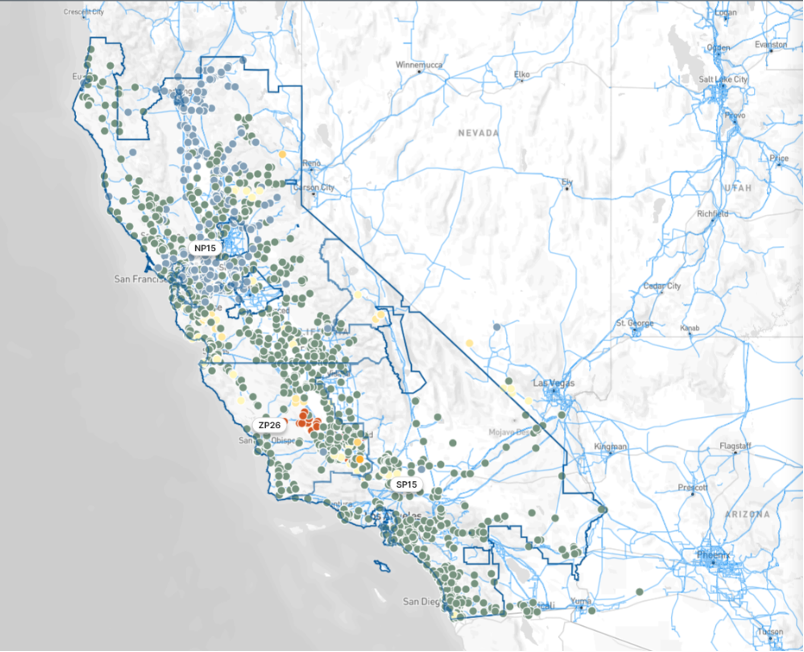
Figure 1. Over 3,500 CAISO nodal price forecasts are available on CoMETS Platform.
CES maintains a long-term view on load and resource supply projections for CAISO. These inputs are informed by CPUC Preferred System Plan (PSP) RESOLVE modeling, long-term SB 100 resource targets and projections, and the collective intelligence of CES’s MarketIQ, Wholesale Services, and Retail Services teams. These inputs are the underpinning of CES’s long-term price forecasting methodology, ensuring that every forecast reflects current market fundamentals and pragmatic, research-driven views on future trajectories.
But CAISO is no longer represented just by California. Launched in May 2026, the Extended Day-Ahead Market (EDAM) has broadened both the supply and demand that CAISO is optimizing for each day. CES incorporates not only PacifiCorp (the current non-CAISO participant), but all committed and projected EDAM participants over the coming years. For each of these participants, CES’s modeling combs through each utility’s Integrated Resource Plan and projected load growth to inform model inputs.
CES applies a rigorous production cost modeling framework to develop long-term, hourly nodal Locational Marginal Price (LMP) forecasts and pairs them with proprietary models, deep market intelligence, and advanced regression methodologies to forecast capacity, ancillary services, and Resource Adequacy prices. Our team leverages industry-standard commercial software in combination with customized economic dispatch models to deliver precise, client-focused forecasting solutions.
Our price forecasting process incorporates:
- 8,760 hourly Nodal LMP forecasts for wholesale energy, covering both Day-Ahead (DA) and Real-Time (RT) markets, over a 30-year horizon for more than 3,500 nodes across the CAISO footprint.
- Hourly Ancillary Services (A/S) price forecasts, including Regulation Up, Regulation Down, Spinning Reserves, and Non-Spinning Reserves, using a regression-based model informed by historical and forecasted installed renewable and storage capacity, load demand, and expected market size by product.
- Annual Resource Adequacy (RA) price forecasts derived from detailed financial modeling of the incoming capacity-eligible resource fleet expected to serve California LSEs through 2055, incorporating BESS capital cost projections, wholesale revenue forecasts, and the premium effects of the Slice-of-Day Framework.
- Basis Risk simulation, allowing users to evaluate locational price separation between node and hub on either a flat, solar-weighted, or wind-weighted basis.
- Near-term benchmarking to publicly traded LMP futures to ensure consistency with liquid market signals; nodal prices calibrated using a machine learning-based framework to capture historical nodal behavior and forecast congestion patterns.
All of these price forecasts, including each of the thousands of nodes and their basis risk, are available on CES’s CoMETS Platform.
Turning Market Complexity Into a Competitive Edge
The problem of forecasting project revenues just got much more complex. Going forward, CAISO’s day-ahead unit commitment problem will now be able to select any resource across any of the participating utilities, and will have to deliver energy to load across multiple states, all while navigating a much larger transmission system. New generation, load, and transmission exponentially increase the optimization problem, introducing new price drivers, congestion risks, and volatility that will alter price formation not just in these new utilities, but within CAISO itself—changing the outlook for projects already under development. To navigate this new terrain, CES uses its CAISO nodal price forecast, driven by the full EDAM market simulation, as the core input to the CoMETS Platform. CoMETS determines the optimal dispatch of standalone and hybrid storage assets to maximize multi-stack market revenues—including arbitrage, ancillary services, and resource adequacy. CoMETS shows not only the expected revenue, but also the P90 and P10 revenue scenarios. Using Markov chain stochastic price simulation based on historical & forecasted volatility, developers can understand the range of potential outcomes for their projects.
CoMETS revenue modeling serves a range of applications across the project lifecycle. For developers and investors, it provides the foundation for project underwriting—translating nodal price forecasts into project-specific revenue projections that account for a battery’s duration, degradation profile, interconnection node, and operational constraints. Users can view nodal heat maps to site their next project, evaluate basis risk, and test different configurations for maximizing future revenues. For offtake negotiations, CoMETS enables CES to model the revenue impact of contract structures, including tolling agreements, capacity contracts, and RA arrangements, allowing clients to evaluate the tradeoffs between contracted certainty and merchant upside. For projects already in operation, CoMETS dispatch optimization can be used to benchmark actual performance against modeled expectations, identify revenue leakage, and refine bidding strategies in response to evolving market conditions.
The Western grid is in the midst of its most consequential market transformation in decades. For storage developers and investors, the margin between success and failure will increasingly come down to the quality of the analytics behind every investment decision. CoMETS was built for the players navigating this moment, delivering the price intelligence, dispatch optimization, and revenue modeling depth needed to succeed in the most competitive markets.
Reach out to mailto:info@ces-ltd.com to schedule a demo of CoMETS today.
By: Devin Gaby