A technical analyst’s verdict on thermal runaway, zero-volt logistics and the certification battle that will define commercial adoption
The battery industry may be approaching a fundamental reset in how it prices safety. Sodium-ion technology is moving beyond laboratory promise and into a harder commercial test: can a different electrochemical architecture deliver a measurable reduction in system risk? Its case extends well beyond abundant feedstock and potential cost relief. Reported advantages include a later onset of thermal runaway, lower oxygen release from selected cathode structures, a more thermally stable hard-carbon interphase, and aluminum current collectors that enable true zero-volt transport. But no chemistry earns a safety premium by reputation alone. For manufacturers, investors and storage operators, the decisive question is whether sodium-ion’s theoretical margin survives cell integration, pack design, abuse testing and certification at scale.
Safety Is a Mechanism, Not a Label
“Sodium-ion is safer” is analytically useful only when the claim is tied to a specific cathode, anode, electrolyte, state of charge and abuse condition. The chemistry does offer credible structural advantages, but broad labels conceal the mechanisms that ultimately determine heat generation, oxygen release, gas evolution and propagation.
Thermal Runaway: More Margin, Not Immunity
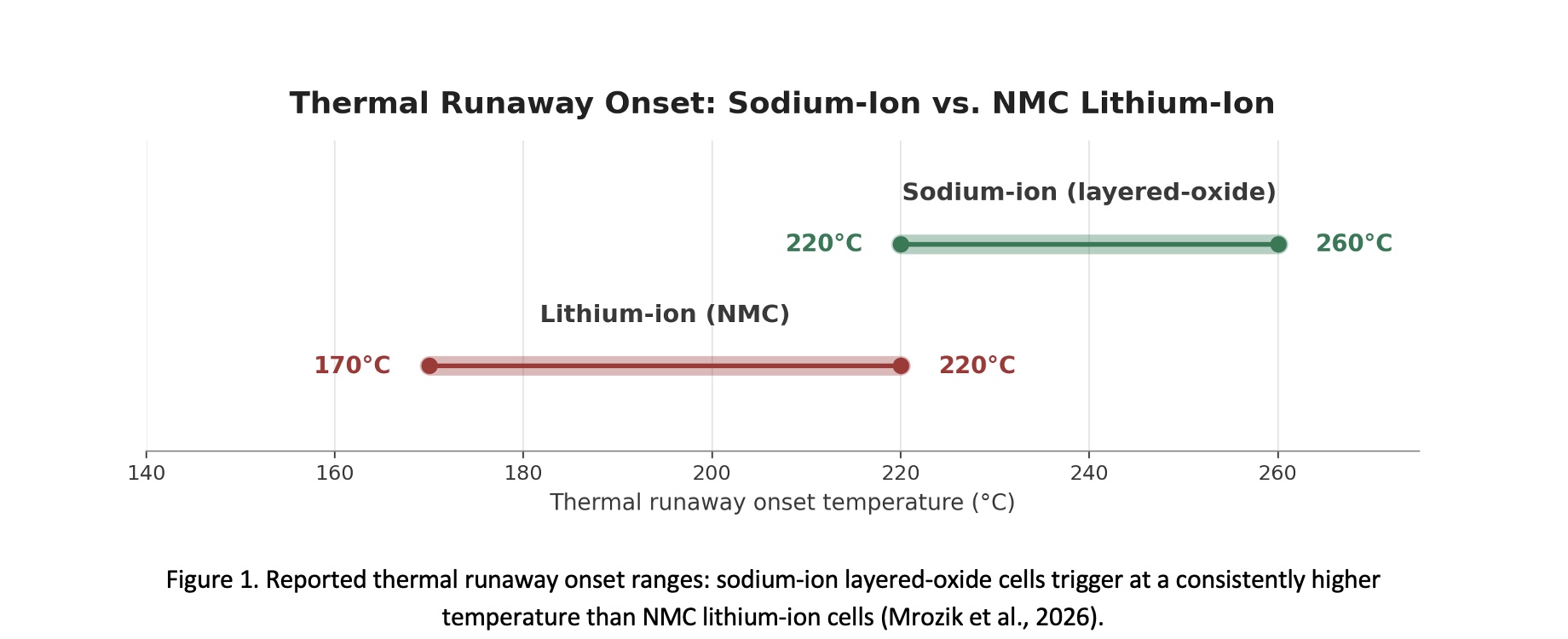
Accelerating-rate calorimetry studies report a consistent margin: sodium-ion layered-oxide cells show thermal-runaway onset in the 220–260°C range, compared with 170–220°C for NMC-based lithium-ion cells, alongside lower overall heat-release rates (Mrozik et al., 2026).
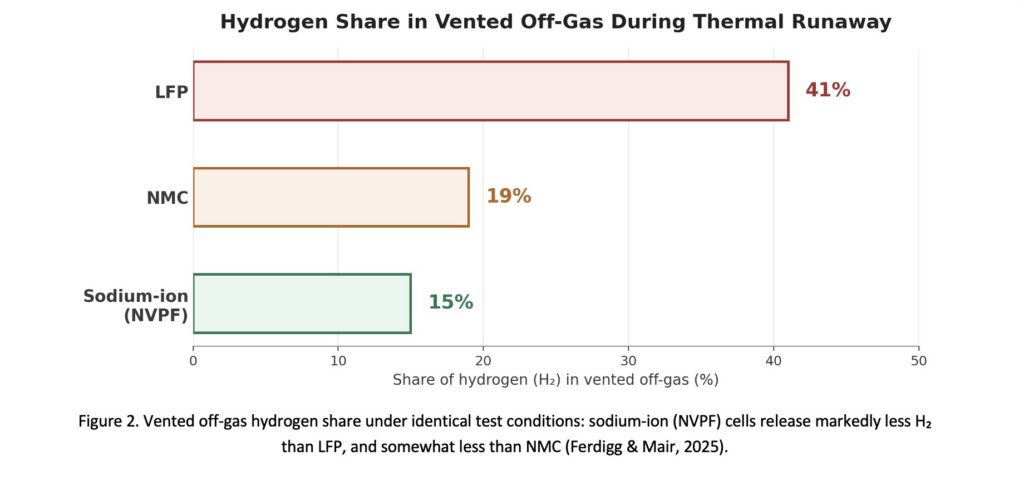
Under a directly matched test protocol, NVPF sodium-ion cells[1] also produced substantially less hydrogen in vent gas: 15%, compared with 41% for LFP and 19% for NMC. This records a reduction of roughly 63% relative to LFP (Ferdigg & Mair, 2025). The implication is material: sodium-ion can extend the intervention window and reduce selected combustion drivers, although the result cannot be generalized across every sodium chemistry or pack architecture.
Two material mechanisms explain much of this margin. First, the solid-electrolyte interphase on a hard-carbon anode is typically richer in thermally stable inorganic compounds such as sodium carbonate and sodium fluoride than the metastable, organic-rich interphase common to graphite-based lithium-ion cells. Second, polyanionic [2] and NASICON [3] cathode frameworks better resist the oxygen-release reactions that intensify thermal runaway in high-nickel oxide cathodes. Their phosphate and fluorophosphate bonds remain more stable under overcharge, crush and external short-circuit abuse.
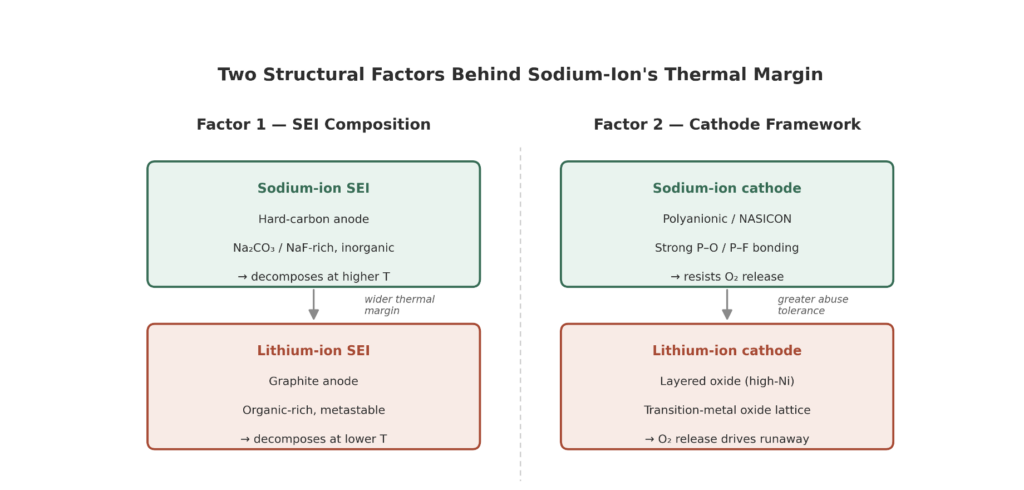
Figure 3. Structural basis of sodium-ion’s wider thermal margin: a more thermally stable, inorganic-rich SEI on the hard-carbon anode, and a polyanionic/NASICON cathode framework that resists oxygen release.
This margin is not unconditional. Because SEI decomposition on hard carbon is slower to initiate, some comparative studies find that sodium-ion cells show a delayed onset of thermal runaway but a more abrupt, higher-gas-release event once the threshold is crossed, driven by accelerated interfacial breakdown.
The correct engineering conclusion is not that sodium-ion eliminates thermal runaway. It is that selected sodium-ion chemistries can create more time, lower specific hazards and improve containment prospects before a failure propagates.
Zero-Volt Transport: A Quiet but Strategic Advantage
The transport case may prove as commercially important as the thermal case. Lithium-ion cells cannot be taken safely to a true zero-volt state because deep discharge can dissolve the copper anode current collector and create an internal short-circuit risk during recharge. Sodium-ion cells can use aluminium on both electrodes, allowing qualified designs to be shipped at 0V without the same corrosion mechanism. That distinction reduces stored electrical energy in transit, simplifies long-duration storage and could ultimately reshape logistics, inventory handling and insurance assumptions provided regulators and carriers recognize the chemistry-specific evidence.
Certification Will Separate Evidence from Marketing
China’s GB 38031-2025: The First Serious Commercial Gate
China’s GB 38031-2025, mandatory from 1 July 2026, raises the safety bar across thermal propagation, underbody impact and fast-charge durability. The standard shifts the industry from a five-minute warning philosophy toward preventing fire and explosion after a triggered cell event for the prescribed test period. CATL’s Naxtra cells and packs became the first sodium-ion products reported to have passed all three categories mentioned as thermal propagation, underbody impact and fast-charge durability through third-party evaluation. Strategically, that certification matters more than any isolated calorimetry result: it demonstrates that a chemistry-level advantage can survive integration into a pack and a defined abuse protocol.
Transport Regulation: Chemistry Is Moving Faster Than the Rulebook
UN 38.3 governs transport safety for both lithium-ion and sodium-ion cells via eight standardized abuse tests (altitude simulation, thermal cycling, vibration, mechanical shock, external short circuit, impact/crush, overcharge, forced discharge). Because sodium-ion’s zero-volt tolerance is a genuine chemical difference rather than a labelling convenience, transport regulators are now developing sodium-specific provisions rather than folding the chemistry under lithium’s existing UN numbers; the IATA Dangerous Goods Regulations’ 67th edition, effective 1 January 2026, introduced a dedicated UN number (UN 3551) for sodium-ion cells and batteries, reflecting a real, if initially lagging, regulatory adaptation to the chemistry’s different risk profile.
Product Safety: Established Standards, Sodium-Specific Evidence
Portable, industrial and stationary sodium-ion products are being assessed through established IEC and UL frameworks, including IEC 62133-2, IEC 62619, UL 1973 and UL 9540A. These standards provide an essential baseline, but they do not remove the need for sodium-specific datasets on vent-gas composition, re-ignition, ageing, propagation and system controls. Reusing a test framework is not the same as proving chemical equivalence.
Where Sodium-Ion Can Win First
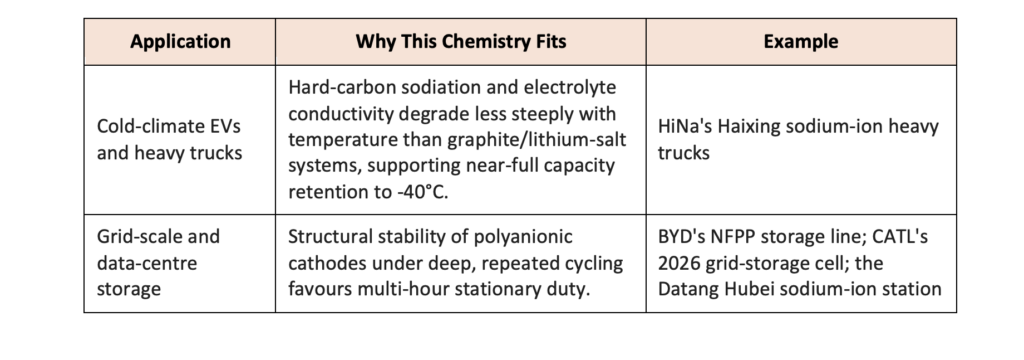
Sodium-ion is unlikely to displace lithium-ion everywhere. Its first wins will come where safety margin, cold-weather performance, deep cycling and logistics simplicity carry more value than maximum gravimetric energy density.
The Analyst’s Verdict: Safety Must Become Bankable
Sodium-ion has moved from a material-science story to an infrastructure decision. Its safety proposition is credible, but it is not binary. The commercial outcome will depend on electrode materials, electrolyte formulation, cell geometry, state of charge, battery-management logic, thermal barriers and enclosure design. In a battery energy-storage system, cell-level stability is only the first line of defence; risk must be controlled across the module, rack, container and site.
References
- Gao, Z. et al., Multiscale Failure Mechanisms and Safety Assessment of Commercial Sodium-Ion Batteries, Advanced Functional Materials, 2026.
- Mrozik, W. et al., Comparative safety analysis of current and next-generation battery technologies, Journal of Power Sources, 670, 239428, 2026.
- Ferdigg, G. & Mair (Essl), C., NVPF Sodium-Ion Versus NMC and LFP Lithium-Ion Batteries in Thermal Runaway: Vent Gas Composition and Thermal Analysis, Batteries, 11(9), 323, 2025.
- Lim, Y. et al., Safety of Sodium-Ion Batteries: Evaluation and Perspective from Component Materials to Cells, Modules, and Packs, Advanced Energy Materials.
- Wang, Y. et al., The safety aspect of sodium ion batteries for practical applications, Journal of Energy Chemistry.
- Luo, Z.-H. et al., Recent progress on the materials design towards thermally safe sodium-ion batteries, Journal of Energy Chemistry, 2025.
- Boozula, A. R. et al., Review of thermal runaway risks in Na-ion and Li-ion batteries: safety improvement suggestions for Na-ion batteries, Journal of Engineering and Applied Science, 2025.
- Wei et al., Comprehensive analysis and mitigation strategies for safety issues of sodium-ion batteries, Rare Metals, 2024.
- GB 38031-2025, Electric Vehicles Traction Battery Safety Requirements, State Administration for Market Regulation / Standardization Administration of China.
- CATL, CATL’s Naxtra Battery Passes New National Standard Certification, September 2025
| Author – Prajwal Thorat, Technical Analyst R&D Services, CES prajwal.thorat@ces-ltd.com |
[1] NVPF (Na₃V₂(PO₄)₂F₃) is a polyanionic sodium-ion cathode in which reversible Na⁺ extraction and insertion are coupled with the V³⁺/V⁴⁺ redox reaction, while the robust phosphate–fluoride framework provides structural stability and enables a relatively high operating voltage.
[2] Polyanionic sodium-ion chemistry uses cathode materials built from rigid anion groups (like phosphate or sulphate) bonded to transition metals, forming a stable framework that sodium ions move through during charge/discharge. This structure offers excellent thermal stability and long cycle life, though usually at the cost of lower energy density compared to layered oxide cathodes.
[3] NASICON sodium-ion materials have a rigid, 3D framework with open channels that let sodium ions move through quickly and easily in all directions. This makes them great for fast charging and long-lasting batteries, since the structure stays stable and barely changes shape during use.