Source: CES, SPP
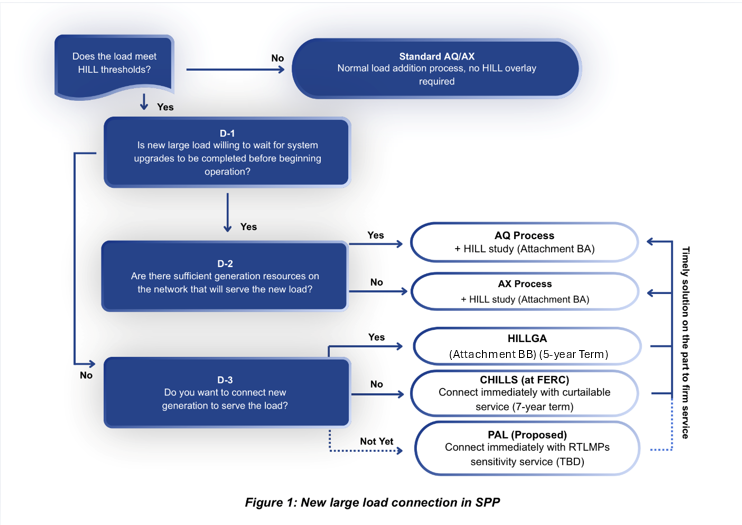
Figure 1: New large load connection in SPP
SPP Load Pipeline: A 26.4 GW Surge Reshaping the Grid
SPP Converts around 27% of 26.4 GW Large Load Requests into
Service Agreements (2021–2027)
Source: CES, SPP
Figure 2: SPP Large Load Outlook
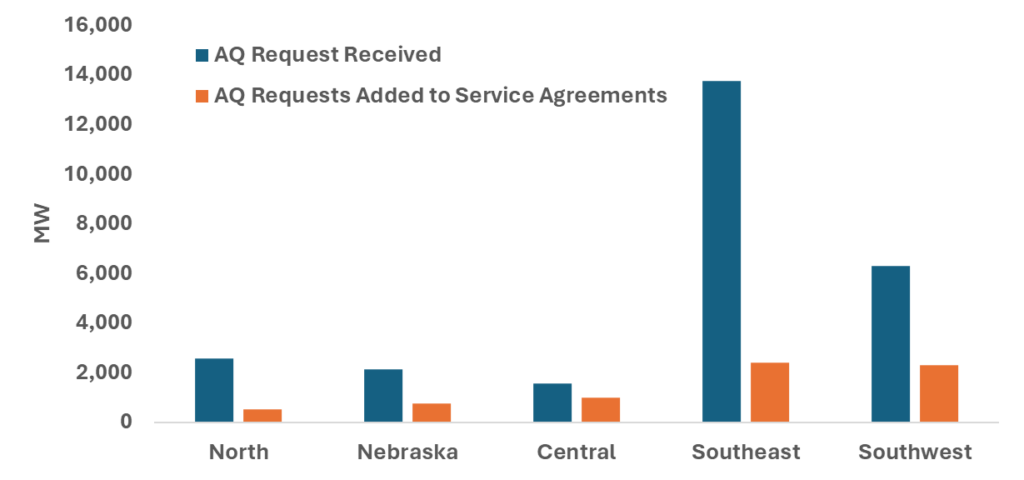
While SPP’s generation queue has attracted more of the attention, the region’s large load interconnection pipeline has quietly become one of the most important forces reshaping the grid. Since 2020, SPP has received approximately 26.4 GW1 of load interconnection requests from facilities exceeding 100 MW, including 9 GW data centers. For perspective, SPP’s current system peak load is roughly 54 GW, meaning that the load requests submitted in just the past few years amount to nearly half the system’s existing peak demand. In 2024 alone, SPP received nearly 6 GW of large load interconnection requests.
At the same time, the study pipeline should not be mistaken for load that is certain to materialize. The conversion rate from initial request to executed service agreement remainsrelatively low. Only around 7 GW had reached executed service agreements with service dates between 2021 and 2027. The gap highlights the limitation of SPP’s legacy load interconnection processes, which were designed for a much slower and incremental pattern of load growth, not to accommodate the speed and scale of today’s large load development cycle.
SPP’s Large Load Interconnection Framework: From Legacy Processes to HILL and HILLGA
ATSS, Attachments AQ and AX
SPP’s existing load interconnection processes, primarily the Aggregate Transmission Service Study (ATSS) process and Attachment AQ, were built for an era of gradual organic load growth, not for today’s reality of multi-hundred-megawatt data center campuses arriving faster than new generation can be developed. Under ATSS, a load serving entity must generally show that it has sufficient Designated Resources (DRs) to serve the forecasted load, effectively demonstrating that adequate generation is available to support the request. Attachment AQ offers a more streamlined alternative in narrower circumstances such as additions, modifications, or abandonments of delivery point facilities for load that can already be served by a transmission customer’s existing DRs. In practice, however, many large load customers could not satisfy these DR-related requirements, leading to delays in the study process and creating a structural bottleneck for new large load interconnections.
Recognizing this issue, SPP filed tariff revision in June 2025 to establish the Provisional Load Process under Attachment AX2, which FERC accepted on October 10, 2025. The key innovation of Attachment AX is that it allows SPP to study new load additions even when the requesting transmission customer does not yet have sufficient existing DRs, so long as supporting generation is expected to come online. This was an important step forward because it gave SPP a mechanism to begin evaluating large load requests that otherwise would have stalled under the legacy framework.
Even so, Attachment AX remains a partial solution rather than a complete fix. However, AX itself does not guarantee firm transmission service or interconnection rights. First, the load must eventually convert its planned generation into designated-resource status through SPP’s existing process. Second, because of the uncertainty around whether the planned supporting generation will actually be built, any required network upgrade costs are assigned directly and temporarily to the requesting load, rather than being socializedacross the broader SPP transmission customer base. This creates significant cost uncertainty. Third, Attachment AX does not fundamentally solve the timing problem: while it allows studies to move forward, those studies still proceed under SPP’s standard engineering review timelines.

Source: CES, SPP
Figure 3: ATSS, Attachments AQ and AX Summary
High Impact Large Load (HILL)
On January 14, 2026, FERC unanimously accepted SPP’s proposed High Impact Large Load (HILL)3 study process for loads either 10 MW or more if connected at a voltage level at or below 69 kV, or 50 MW or more if connected above 69 kV, effective from January 15, 2026. The HILL framework, set out in OATT Attachment BA, does not replace Attachments AQ or AX, it overlays them with enhanced study and operational requirements specifically calibrated for large loads that pose unique reliability challenges.
When a transmission customer requests to add or modify a delivery point associated with a HILL, the request flows through either Attachment AQ or Attachment AX. In either case, SPP layers additional study requirements on top through new HILL Supplemental Load Connection Study (HSLCS) and HILL Delivery Point Study (HDPS) that uses more rigorous analyses than standard AQ or AX studies to evaluate the large load’s reliability impact. The goal is to allow SPP to evaluate these large load requests on an expedited basis and support interconnection decision within 90 days.
High Impact Large Load with Generation Interconnection Assessment (HILLGA)
Even with this expedited structure, interconnection through the HILL process still depends on whether sufficient generation and transmission capacity is available to support the new load. Because many areas within SPP are already short on generation, this remains a major constraint for large load interconnections. That challenge is what led to the creation of the HILLGA, under Attachment BB.
HILLGA is intended to accelerate the interconnection of generation resources that are being developed specifically to support HILL. For data center developers, this is especially important because it offers a potential solution to the time-to-market challenge that often arises when load growth outpaced available supply. A developer may, for example, co-develop generation alongside the load or enter into a tolling arrangement for nearby generation developed by another party in order to bring the facility online on a commercially viable timeline.
That said, there is an important structural limitation. Because all SPP states are traditionally regulated jurisdictions, only the applicable load-serving entity may directly serve retail load. As a result, data center developers and generation developers cannot use the HILLGA pathway on their own, they must coordinate with the local utility in order to pursue this structure.
HILLGA also does not provide a permanent standalone pathway for generation interconnection. Under SPP’s tariff, generation interconnected through HILLGA must transition into the standard generation interconnection queue within five years. If the HILLGA customer wants the generating facility to remain interconnected beyond that five-year period, it must submit a separate generation interconnection request through SPP’s standard process, which is now transitioning from DISIS to the Consolidated Planning Process, as described in Part 2.
The Next Frontier in Large Load Interconnection: CHILLS and PAL
Conditional High Impact Large Load Service (CHILLS)
While HILL and HILLGA were accepted by FERC in January 2026, CHILLS followed a separate and more contentious path. CHILLS was originally part of the broader HILL/HILLGA proposal4, but it was removed from the initial filing after it failed to advance through the Market Working Group in September 20255. SPP later revised the concept and filed proposed tariff revisions with FERC in February 20266, requesting an effective date of July 1, 2026.
CHILLS is designed to address a gap that AQ, AX, and HILLGA do not fully solve that is how to serve a large load that needs to energize before all required network upgrades are completed and before its designated resources are fully operational? In that sense, CHILLS functions as a conditional bridge to long-term firm service.
Under CHILLS, a HILL could begin taking power from the grid on a curtailable basis using transfer capability that remains available after higher-priority load (network load, firm point-to-point transmission customers, etc.). The maximum term is seven years, extended from the five-year term in the earlier proposal. During this period, if the transmission system becomes constrained or enters emergency conditions, CHILLS load would be curtailed on a non-discriminatory basis based on available system capability. Its service priority would be below firm transmission service and would be roughly comparable to monthly Non-Firm Point-To-Point Transmission Service. Neither SPP nor the transmission owners would have any obligation to plan the transmission system to serve the CHILLS load. Loads taking CHILLS therefore will do so with the understanding that it is strictly availability-based and may be curtailed or interrupted.
Price Adaptive Load (PAL)
The fourth pillar of SPP’s large-load interconnection suite, PAL remains in the design phase but represents SPP’s forward-looking approach to demand-side flexibility after its stakeholder provided the feedback to seek a different approach. SPP submitted the PAL initiative through its stakeholder process7 to start its development and target Q4 2026 for executive committee approval.
Rather than using CHILLS as the only non-firm option for large load, stakeholders asked for a more flexible, market-based alternative. PALS is that alternative proposal. It is not designed as a bridge to firm service, and it is not intended to support load until dedicated generation or transmission upgrades are in place. Instead, it is built specifically for loads that are willing to be price-responsive and accept non-firm, highly interruptible service from the outset. This distinction is important as CHILLS is still tied to the broader HILL framework and is essentially meant to help a large load come online sooner, even if the service is conditional and subject to curtailment. On the other hand, PALS is not really an early-stage version of firm service at all. It does not require supporting generation, does not require a generation interconnection agreement, and does not rely on the type of transmission planning or study structure associated with HILL or CHILLS. Instead, it is intended for loads that can adjust consumption in response to market prices and operateunder a service model that is fundamentally non-firm by design.
For that reason, PALS is best understood as an alternative to CHILLS for a very specific category of customer. It may work for highly flexible industrial or opportunistic loads, such as bitcoin mining or other interruptible operations, that can reduce usage quickly when prices rise or system conditions tighten. It is not a suitable framework for mission-critical facilities such as data centers that require dependable and continuous power service. In short, CHILLS is a controversial non-firm pathway intended to help large load come online sooner, while PALS is the alternative proposal for loads that are willing to remain non-firm and operate primarily as flexible, price-responsive demand.
The Reinforcing Cycle: How Large Load Growth Reshapes SPP
Large load growth does not simply just add demand to the system. It sets off a reinforcing cycle that intensifies the resource adequacy and interconnection challenge that we have discussed in previous articles.
New large loads increase demand, which widens the capacity shortfall described in Part 1. That growing shortfall increases the need for new generation resources. Those new resources, in turn, must move through the interconnection processes described in Part 2, adding even more volume to an already crowded queue. As queue volume rises, study timelines become longer, restudy risk increases, and commercial operation dates move further out. In the meantime, additional waves of large load continue to emerge, placing even more pressure on the system.
The SPP Opportunity
Take together, this three-part series describes an SPP market at a structural turning point.
Part 1 – Resource Adequacy showed that SPP needs new capacity urgently. Reserve margins are tightening, retirements are mounting, winter planning requirements are becoming more stringent, and battery storage currently retains strong ELCC value at today’s penetration levels. In other words, the need for new reliability resources is real and immediate.
Part 2 on generation interconnection showed how difficult it is for new resources to reach the grid. The queue remains massive, development timelines are uncertain, and speed-to-market has become a defining competitive advantage. At the same time, reforms such as the Consolidated Planning Process and opportunities such as surplus interconnection are beginning to reshape how developers position projects.
Part 3 on large load interconnection showed that the demand side is evolving just as quickly. The HILL and HILLGA frameworks create a new expedited pathway for generation serving large loads, while CHILLS and PAL reflect SPP’s continuing effort to address the practical realities of energizing large customers under constrained system conditions.
What makes this moment especially important is the interaction among these three forces. Large load growth increases urgency on the resource adequacy side, while also putting more pressure on the interconnection process. That interaction creates a compounding opportunity for developers, utilities, and counterparties that can move quickly with flexible and dispatchable capacity. Over the next several years, the most successful participants in SPP are likely to be those that understand not just how each of these trends individually, but how they reinforce one another. The capacity gap creates the need, the interconnection framework determines who can respond, and large load growth magnifiesboth the urgency and the value of being able to deliver.
Written by: Fu-An “Ann” Yu and Shivam Chauhan.