CES MIQ Client Advisory | April 2026
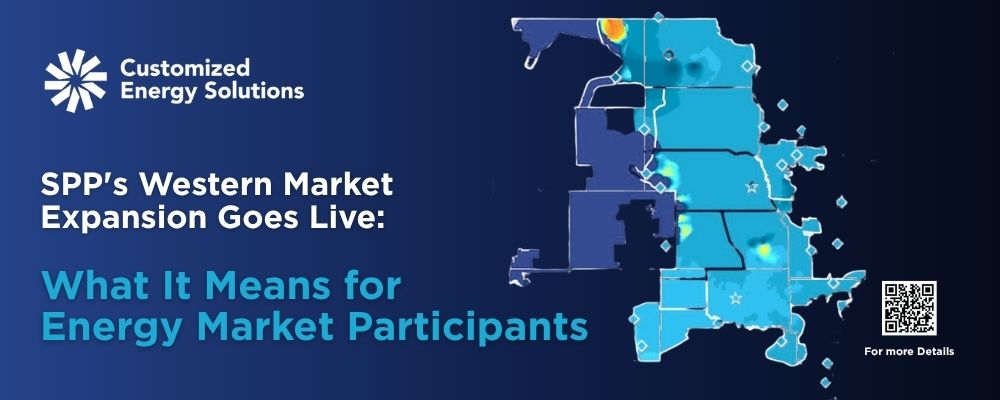
Southwest Power Pool (SPP) has officially launched its RTO Expansion (RTOE), bringing the new West Balancing Authority Area (West BAA) into SPP’s Integrated Marketplace. The region largely incorporates the Western Area Power Administration (WAPA) – Rocky Mountain Region (WACM), covering primarily Colorado and Wyoming, and additional portions of the WAPA – Upper Great Plains (WAUW) region of Montanna into SPP’s territory. The new West BAA marks one of the most significant expansions of organized wholesale electricity markets in the United States in recent years.
The tariff revisions underpinning the RTOE market structure received unanimous FERC approval on March 20, 2025, under Docket Nos. ER24-2184 and ER24-2185 (here), with compliance filings accepted as recently as July 2025. The unanimous Commission approval was widely viewed as a milestone moment, validating years of collaborative tariff development between SPP staff, existing RTO members, and incoming western entities. The expansion introduces new market rules, settlement mechanics, and market power mitigation frameworks specifically designed for the unique physical characteristics of the West BAA and its limited interconnection with SPP’s existing eastern footprint.
The broader industry reception has been strongly positive. SPP described the expanded tariff as the product of years of collaboration that improves grid reliability and provides economic benefits for entities in both the Eastern and Western Interconnections. Incoming western members have broadly expressed enthusiasm for the transition, citing the tangible value of full RTO participation including access to day-ahead and ancillary services markets, efficient regional transmission planning, a single governing tariff structure, and a participatory governance model. Industry analysts have characterized the RTOE as one of the most significant structural changes in U.S. wholesale power markets in recent years, and notably, SPP is now the first RTO in the country to operate organized wholesale markets spanning both the Eastern and Western Interconnections.
The expansion is estimated to save western utilities approximately $49 million annually (here), driven by the ability to access a broader and more diverse resource portfolio, optimize dispatch across a larger geographic footprint, and reduce congestion through coordinated transmission planning. Western participants also gain access to day-ahead market products and ancillary services revenues that were not available under the prior Western Energy Imbalance Services (WEIS) framework.
At the heart of the new market structure is the relationship between the East and West BAAs, which are connected only by DC ties, high-voltage direct current links that serve as the sole conduit for power transfer between the two regions. With a maximum combined transfer capacity of 310 MW at launch, this limited interconnection has important implications for how prices form, how congestion is managed, and how generators are expected to offer into the market.
SPP’s independent Market Monitoring Unit (MMU) has designated the entire West BAA as a Frequently Constrained Area (FCA), a formal recognition that the market’s physical structure creates conditions where market power mitigation measures are warranted. This designation affects how generators offer energy and reserves into the market and how prices are determined when the DC ties are at capacity.
For load-serving entities, generators, and transmission customers operating in Colorado, Wyoming, and Montana, the RTOE go-live is a significant transition. Participants who previously operated under the WEIS framework are now subject to the full suite of SPP Integrated Marketplace rules.
Market design questions will continue to evolve as SPP gains operational experience in the West BAA. The MMU has committed to annual reviews of market structure and FCA designations, and further rule development is expected as real market data becomes available.
New Members and the Road Ahead
The West BAA enters the SPP Integrated Marketplace with a diverse roster of new members. Joining SPP as part of the RTOE are Basin Electric Power Cooperative, Colorado Springs Utilities, Deseret Power Electric Cooperative, the Municipal Energy Agency of Nebraska, Platte River Power Authority, Tri-State Generation and Transmission Association, and WAPA, a group spanning federal power marketing agencies, generation and transmission cooperatives, and municipal utilities that collectively bring significant generation and load to the SPP footprint.
Looking ahead, the regulatory framework governing long-term investment decisions in the West BAA is still taking shape. FERC accepted SPP’s Consolidated Planning Process (CPP) in Docket ER26-414 (here) in March 2026, a landmark framework that integrates regional transmission planning and generator interconnection into a single unified process for the first time in SPP’s history. The CPP is designed to proactively identify where transmission capacity is needed across both the East and West BAAs, establish pre-approved interconnection locations, and provide generation developers with upfront cost certainty before they enter the queue. However, the transition study that will establish initial interconnection cost rates and planned interconnection locations for the West BAA is not expected to be completed until late 2026, meaning new generation development in the region will operate under interim procedures in the near term. Market Participants with generation development or transmission interests in the West BAA should monitor continuing development of CPP closely, as the CPP rules governing how projects interconnect and how transmission upgrade costs are shared represent a material departure from prior processes, and their full implementation remains ahead.
The CES MIQ SPP team is actively monitoring RTOE market developments and looks forward to continuing to support clients navigating the evolving market design landscape in the West BAA and across SPP’s broader footprint. If you have questions about how the RTOE go-live affects your organization’s market position or regulatory obligations, please reach out to our team.
Sources: SPP MMU, RTOE West BAA Frequently Constrained Areas Initial Study, March 2026; FERC Docket No. ER24-2184-002, Issued July 11, 2025; FERC Docket No. ER26-414, Issued March 13, 2026.